React · module 22
React
Build crosslinked networks (sulfur-cured or peroxide-cured rubber, epoxy–amine, ENR with acids or MAH, esterification) with your own force field re-applied after every cycle.
Open it Top bar›React
- You start with
- A cell with a force field (React re-types the network with it after each cycle).
- You get
- The network, a link map, gel point, ν, Mc, DC and a report; or LAMMPS fix bond/react templates.
Step by step
Assign the force field first
Do the Force field step on the cell. React types, charges and parameterises the network with it after every cycle.
Choose the reaction
Under Reaction templates pick a category and a reaction (C–C crosslink, sulfur donor, peroxide (allylic C–C), ENR epoxide + COOH, epoxide + primary amine, anhydride + alcohol …), then Add to the reactions. Editor… shows and edits the template; Import LAMMPS… reads any fix bond/react pre/post/map set.
Sulfur cure: add the donors
Under Sulfur donors set the Sₓ range and the dose in phr (2.5 by default) and press Insert. A donor that reaches two chains becomes a C–Sₓ–C bridge.
Remove pendant sulfur groups afterwards takes out the C–Sₓ–H groups left on one carbon after the cure and gives that carbon its hydrogen back; the summary counts them (
caps react --remove-pendant).Set the network target
Keep Links only between different chains on. Stop at a conversion, a number of links, links per chain, crosslink density ν, Mc or DC %.
To cure only part of the cell, select it first (the query
chain 1-2, or chosen allylic carbons) and tick Only the selected atoms react: atoms of the chains then form bonds only where they are selected, while the sulfur donors and other small molecules are free to react (caps react --only "chain 1-2", Pythonreact(..., selection=True)). After a cure,chain Nstill selects chain N as it was grown (also from a LAMMPS data file CAPS wrote; other formats keep no record), andmolecule Nthe joined network.Choose whether byproducts (H₂, H₂O) stay in the cell.
Choose the protocol
Polymatic cycle (react, relax, repeat) or REACTER-style during MD. Capture distance (0 = the template's), cycles, reactions per cycle and T. Auto capture widens the search when no pair is found.
Press Crosslink
The live view colours each chain and highlights new links; the plots show links between chains, the gel point and the network against your target.
Save, or run it in LAMMPS
Save network… writes the result. Under LAMMPS fix bond/react, Write files… writes pre/post templates, map files, a data file with every type the reaction creates and an input; run
lmp -in react.in.
The same without the Studio
Every Studio page calls the same core as the caps command and the caps Python package, so a step you clicked can be repeated in a script.
caps react --list-templates
caps react cell.data -o network.data --template cc_crosslink \
    --cycles 50 --per-cycle 5 --target 0.3 --temp 500 --seed 1
import caps
d = caps.polymer("*CC(C)=CC*", dp=10, chains=6, density=0.6, seed=1) # cis-1,4-polyisoprene
d.relax(max_iterations=300)
d.field.assign("oplsaa2024")
print(d.react("peroxide_allylic", cycles=5, per_cycle=4, target=0.3, seed=1))
d.save("nr_xl.data")Where to go next
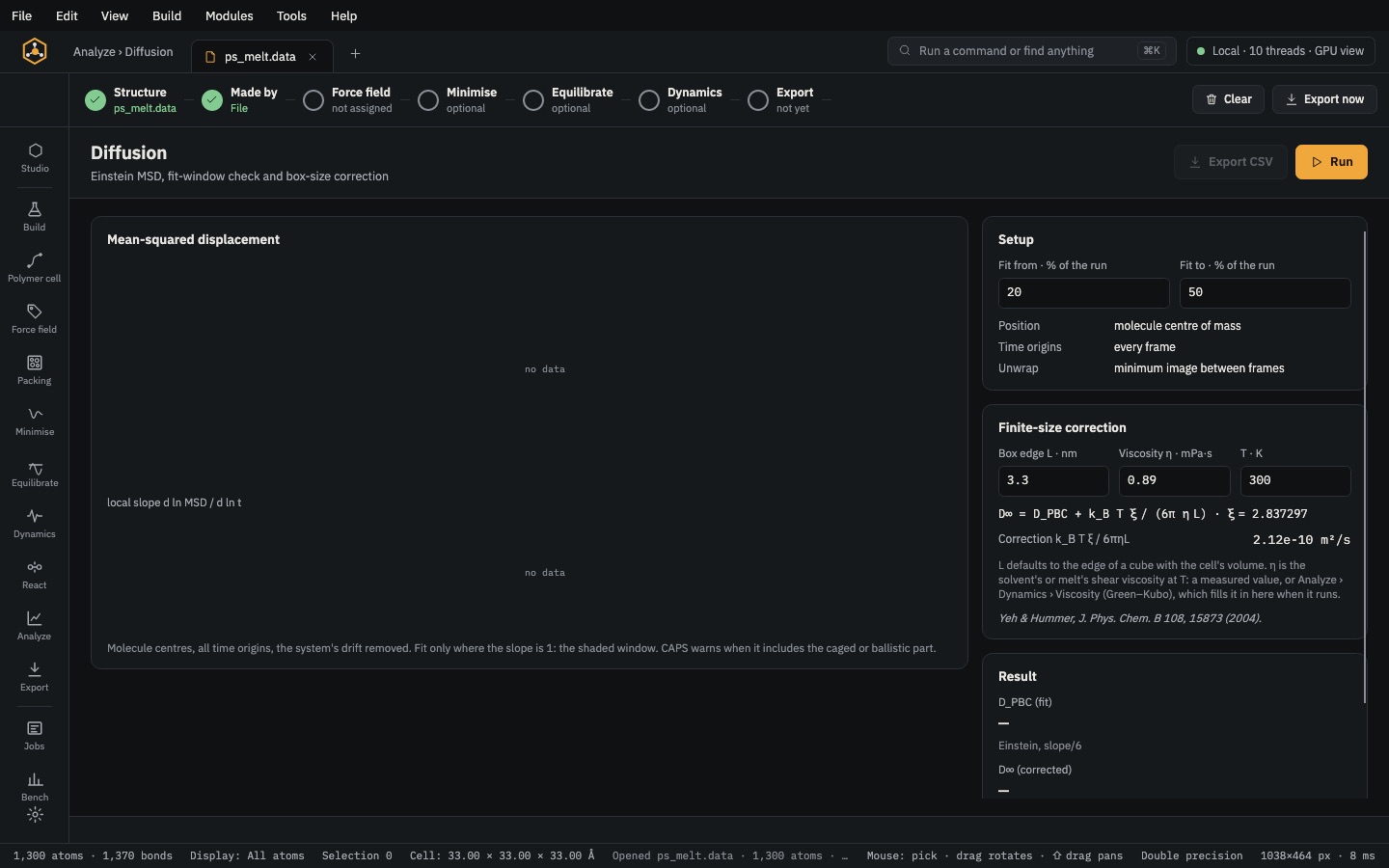 Analyse & exportAnalyzeDensity, g(r), chain statistics, Tg, moduli, diffusion, free volume, interfaces and crosslink density, each with CSV.
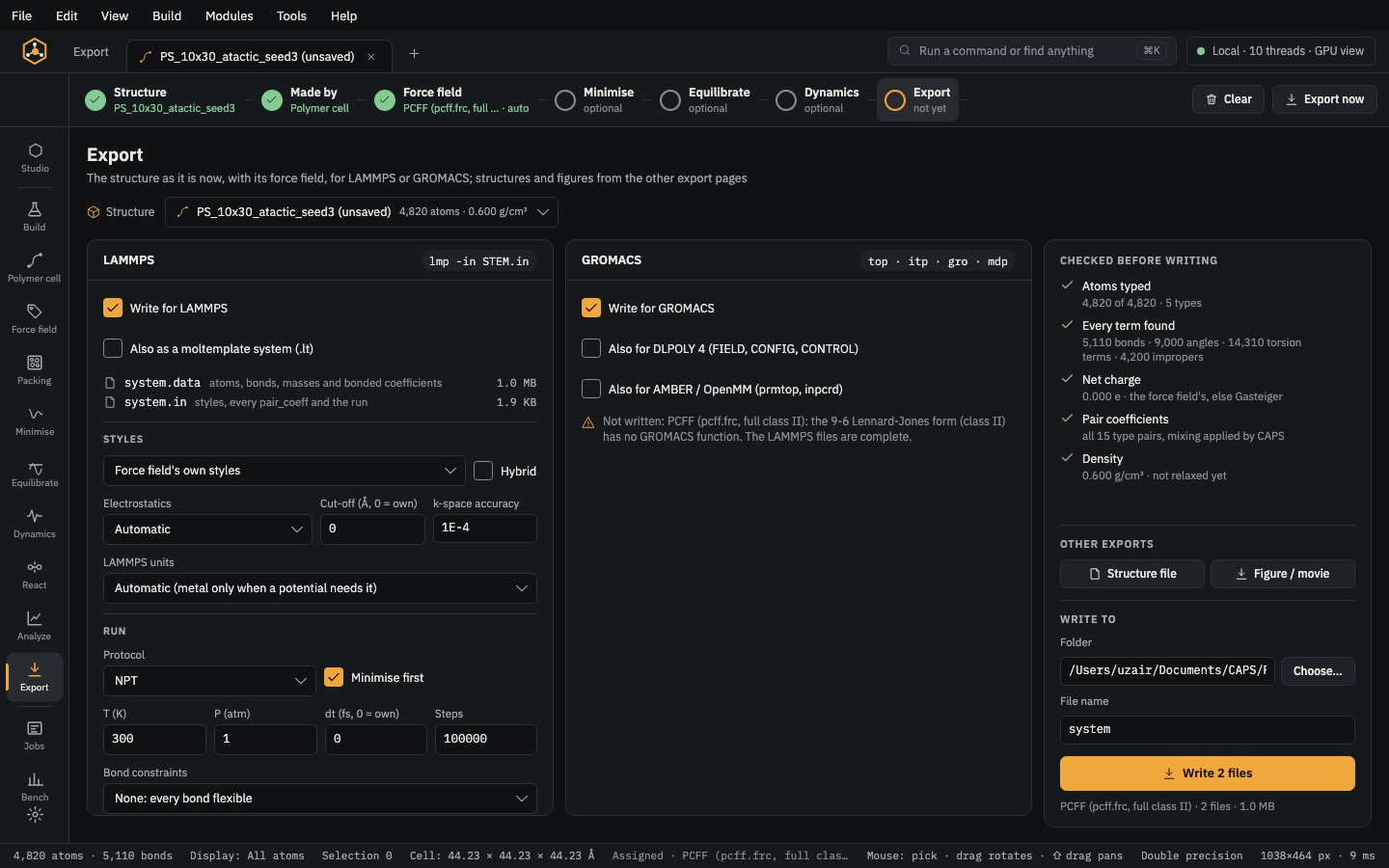 Analyse & exportExportLAMMPS, GROMACS, DL_POLY 4, AMBER/OpenMM and moltemplate decks, checked before they are written.