CAPS Studio
Modules
Every page of the Studio, in the order a project uses them. Each guide shows the page, walks through it step by step, and gives the same step as a caps command and in Python.
Get started
The window every module lives in: open files, find pages with ⌘K, and follow the pipeline strip.
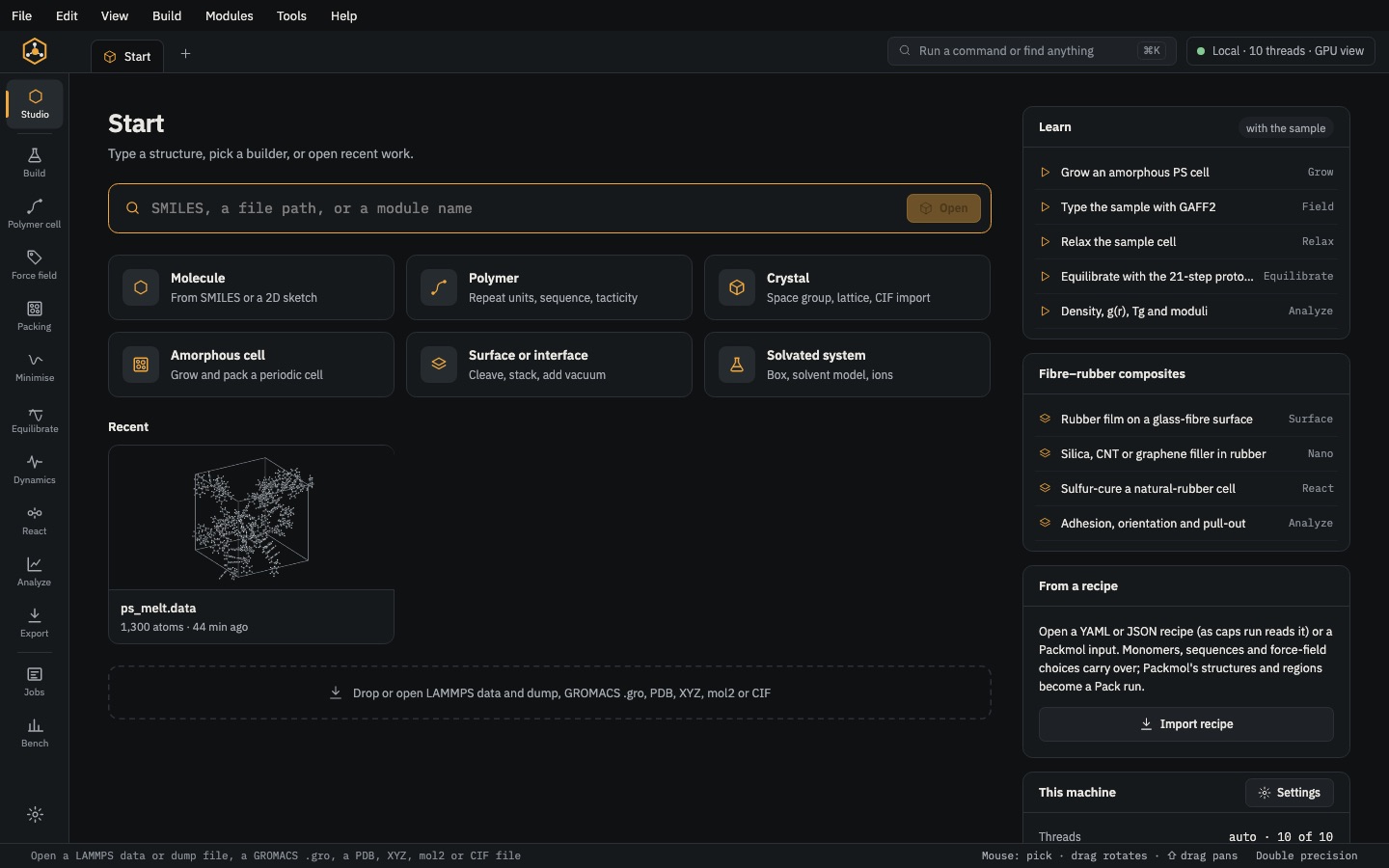 Start
Start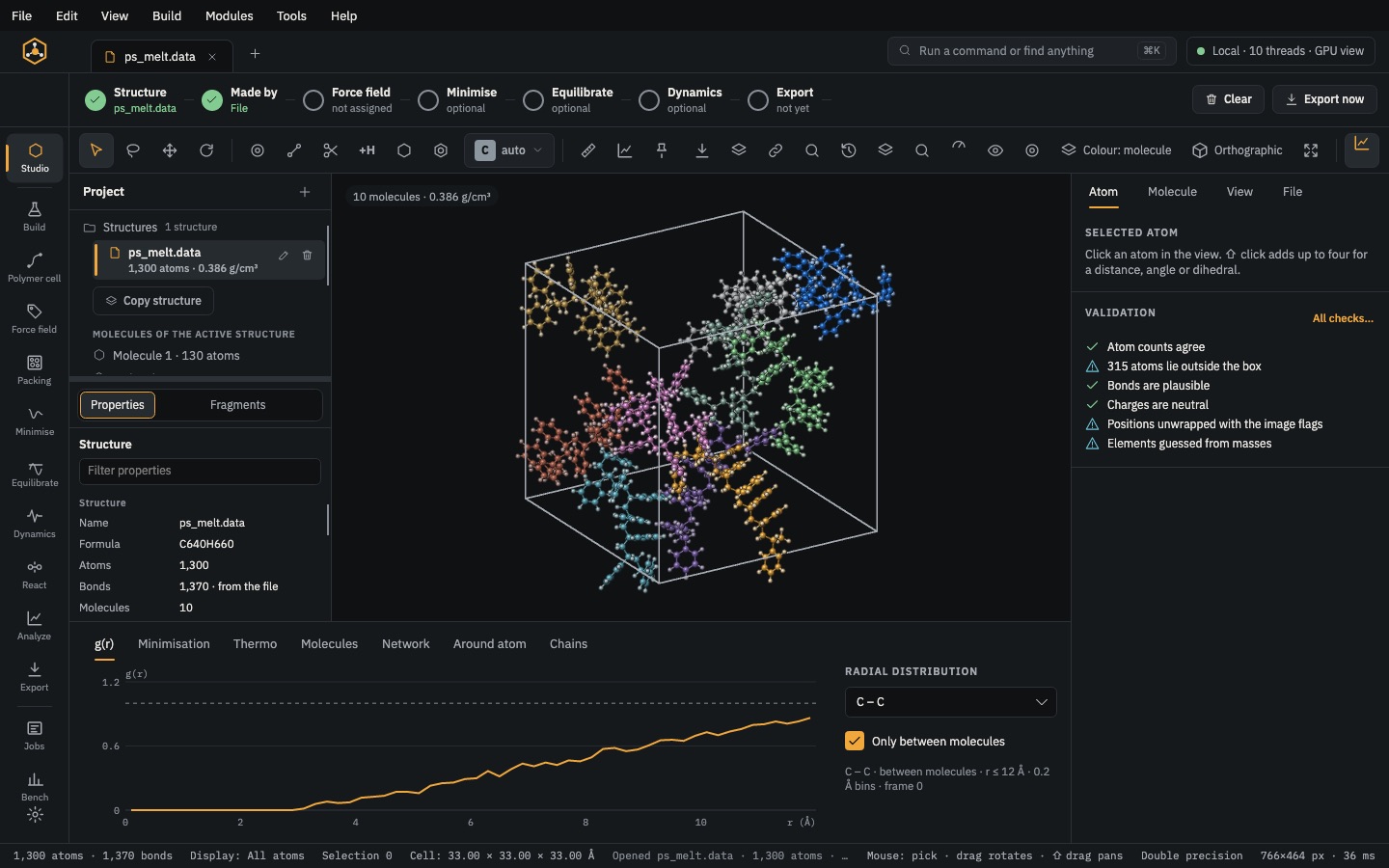 Studio
Build
Make the structure: molecules, polymers, amorphous cells, packed boxes, crystals, slabs, fillers and solvated systems.
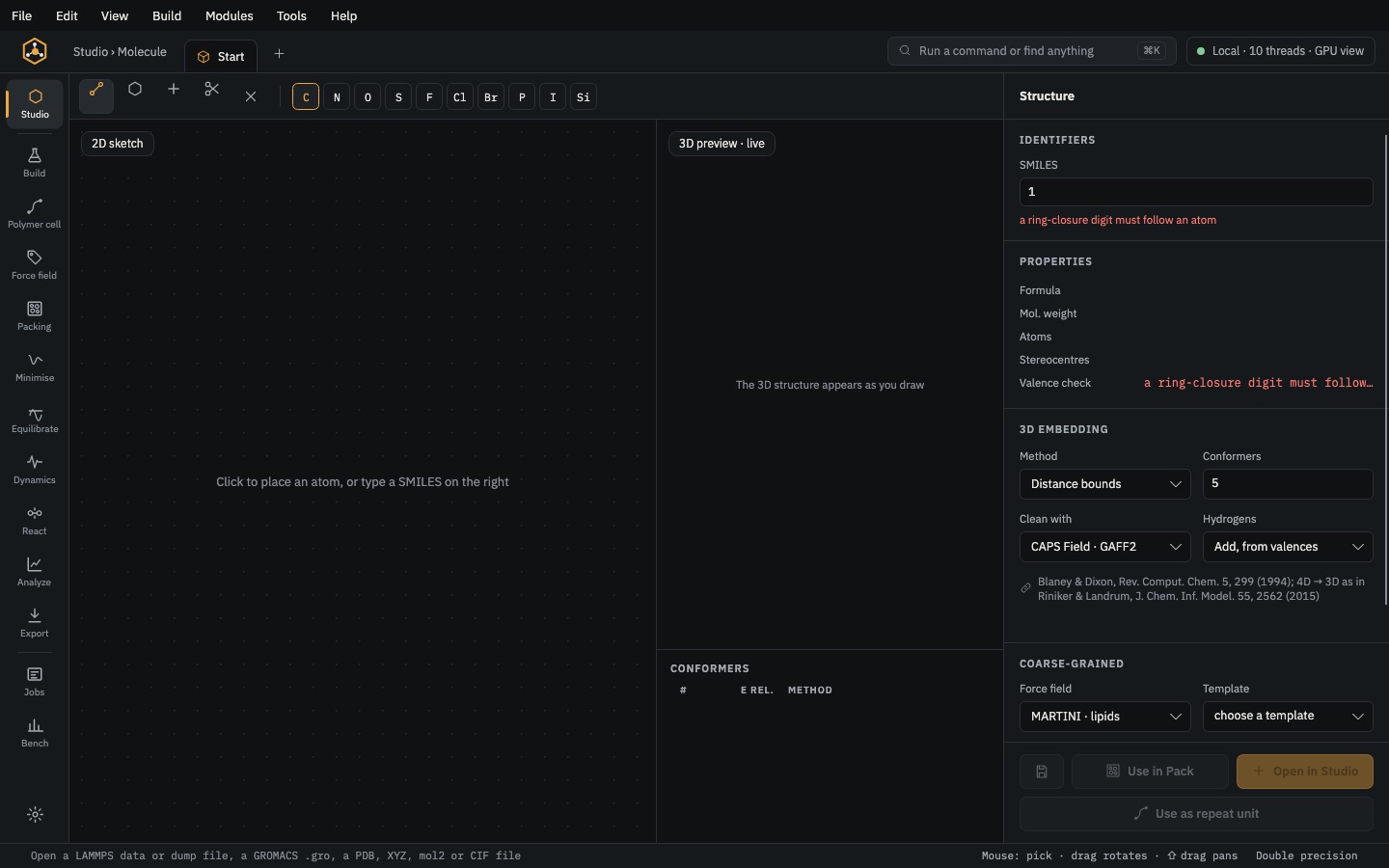 Molecule builderDraw or type a SMILES and get 3D conformers: monomers, curatives, solvents and additives.
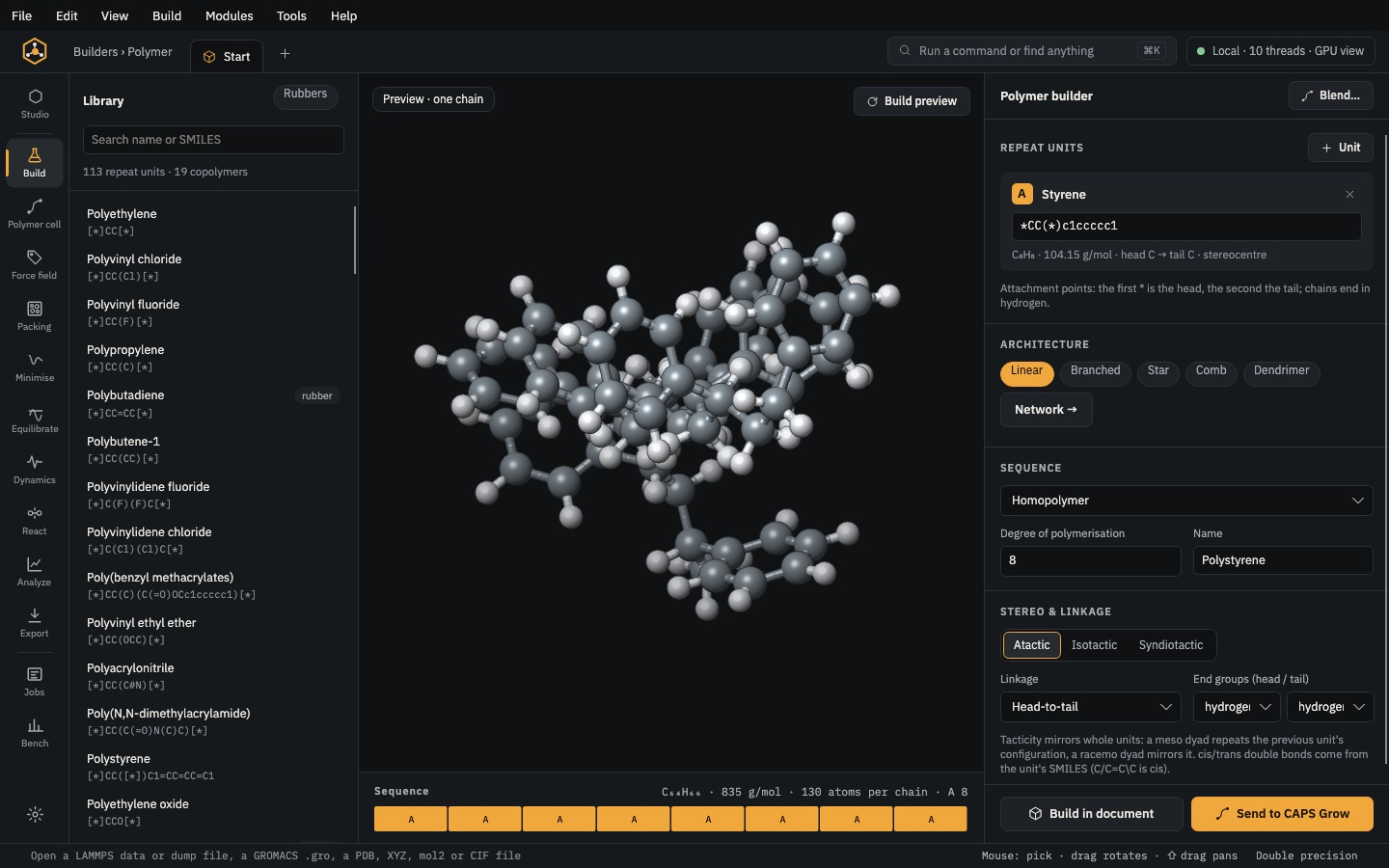 Polymer builder114 repeat units and 21 copolymers, or your own SMILES; architecture, sequence, composition, tacticity and end groups.
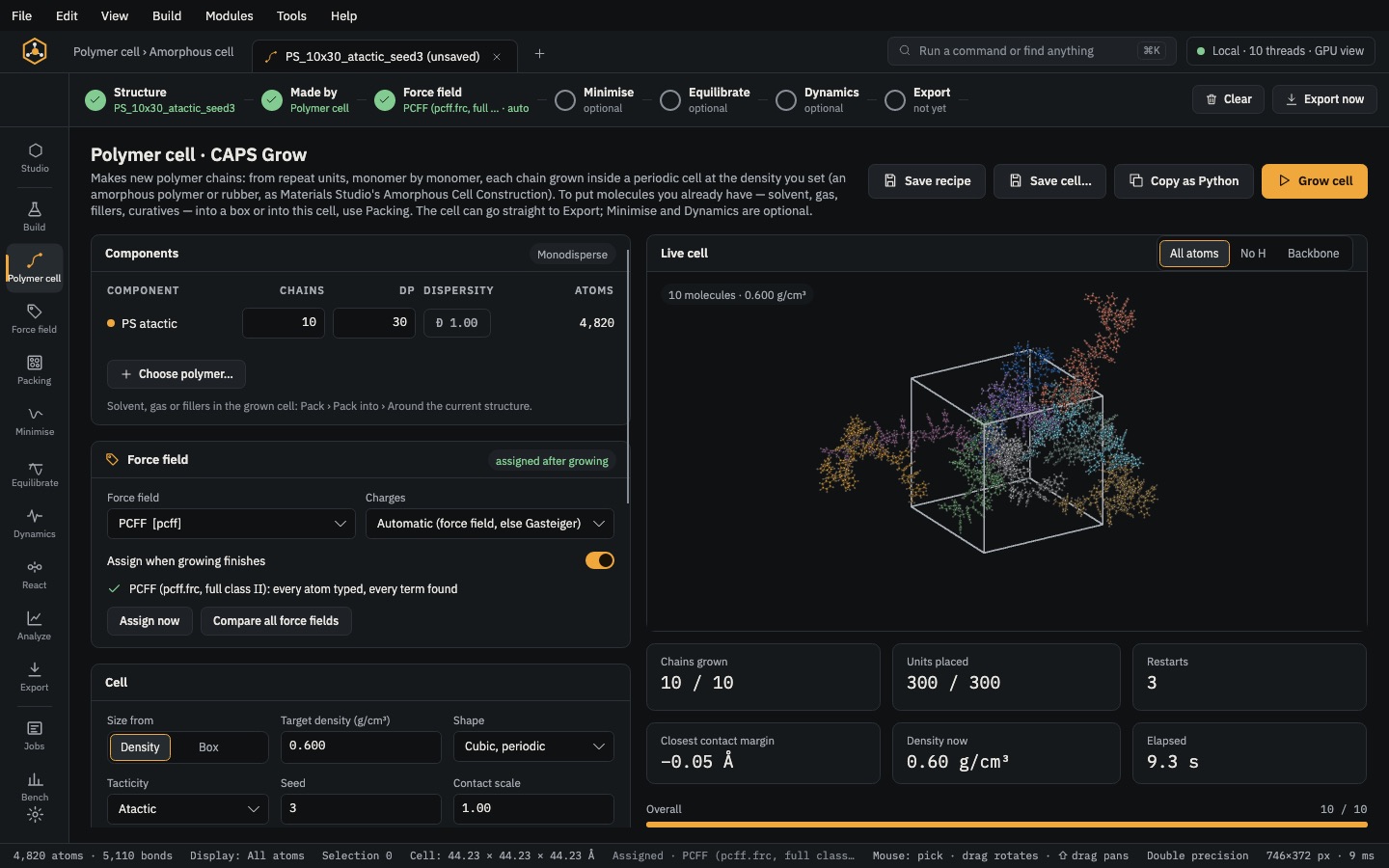 Polymer cellGrow amorphous chains into a periodic cell at a target density, with the force field assigned when growth ends.
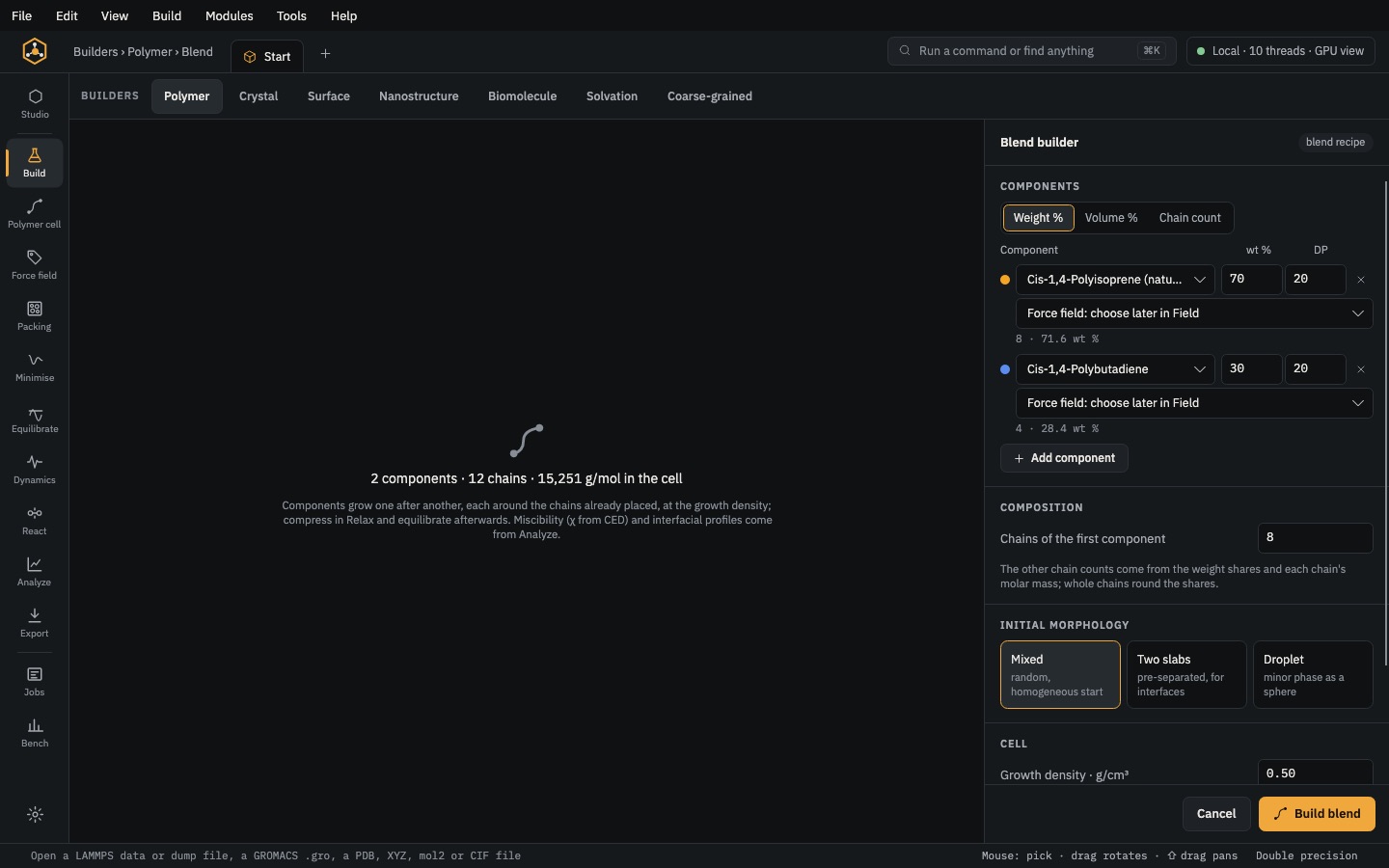 BlendSeveral polymers grown together in one cell: mixed, as two slabs, or as a droplet.
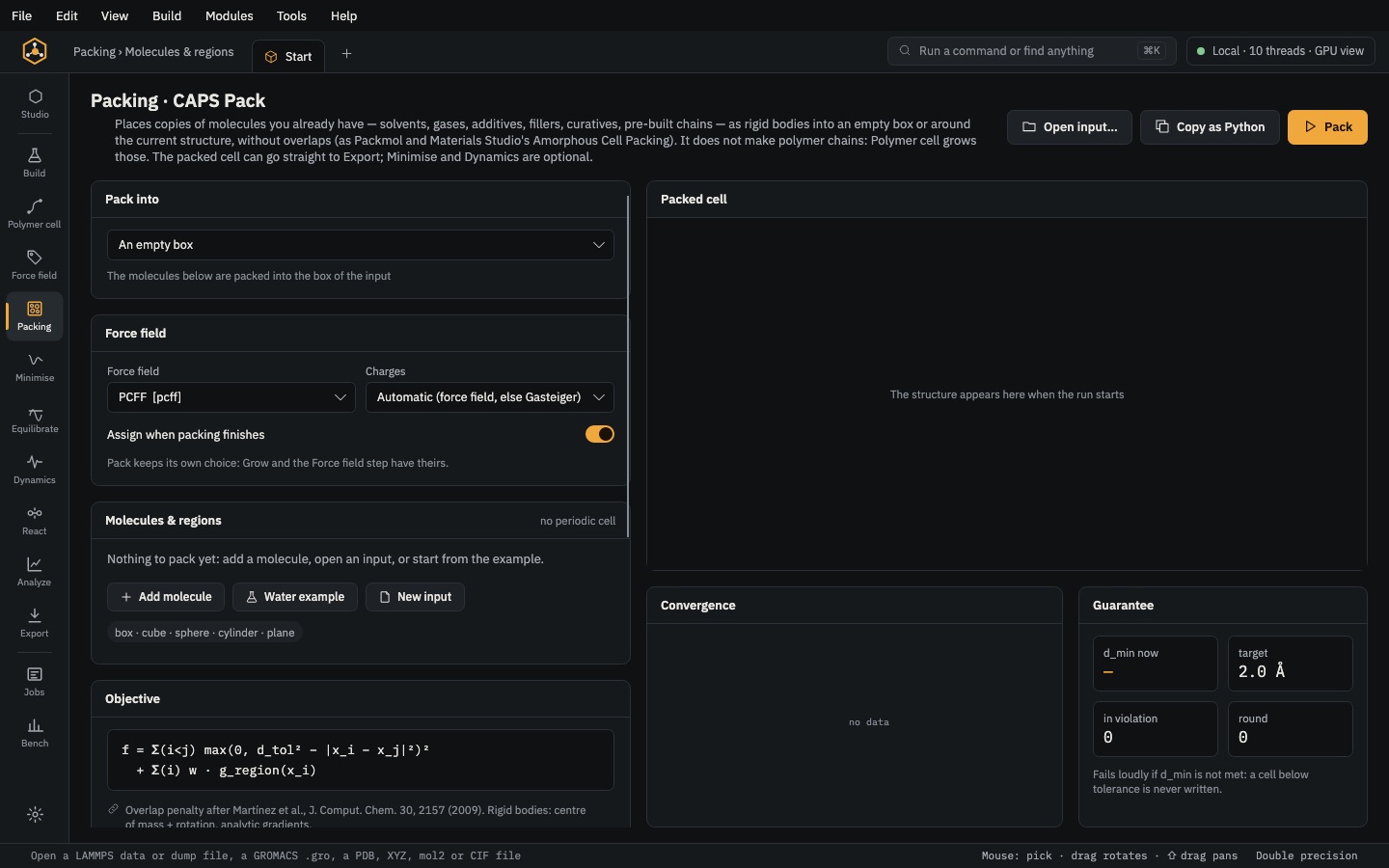 PackingFill a box — or the space around a structure — with molecules, with no two closer than a tolerance.
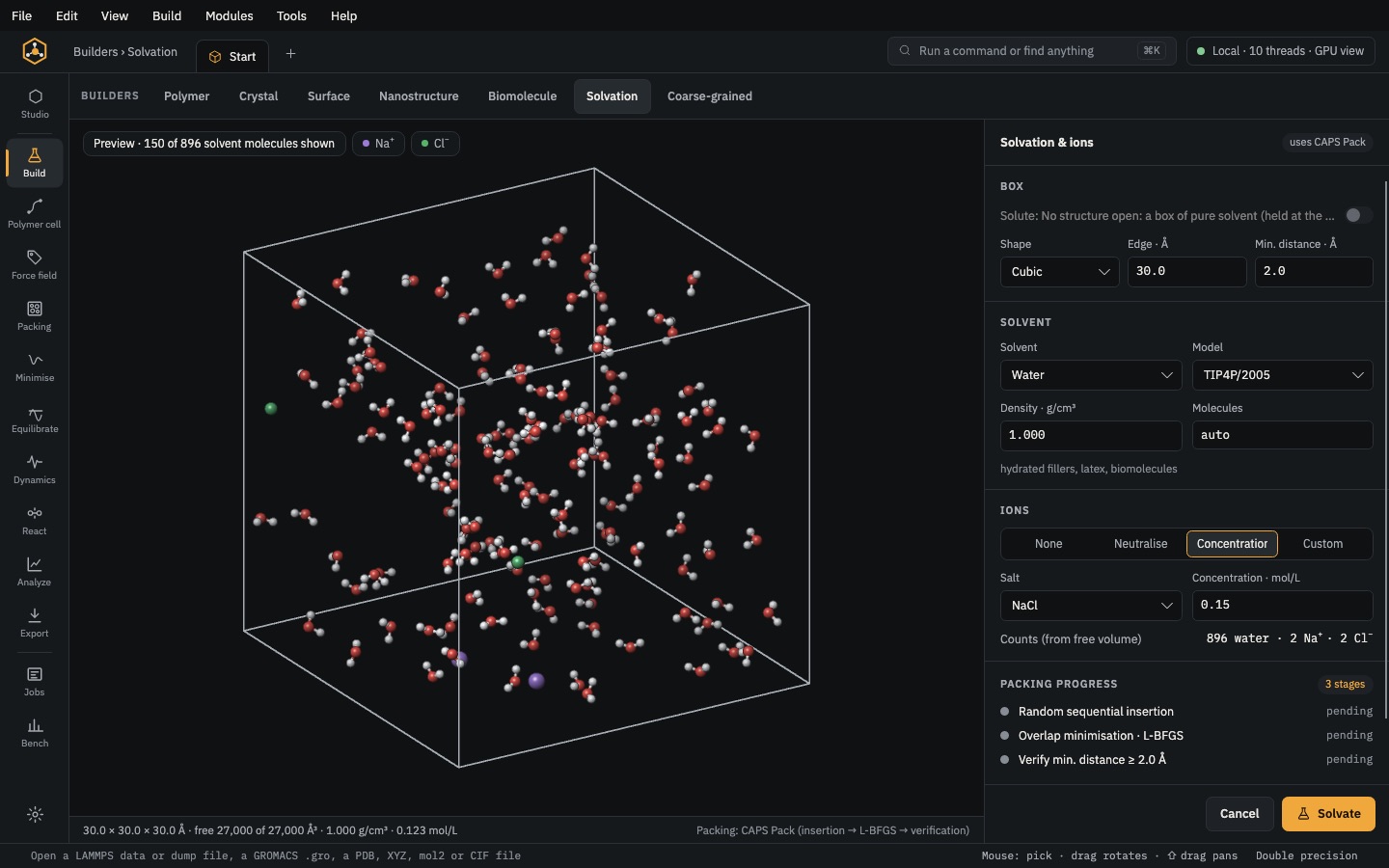 SolvationSolvent and ions around a solute: box shape, solvent model, salt concentration or neutralisation.
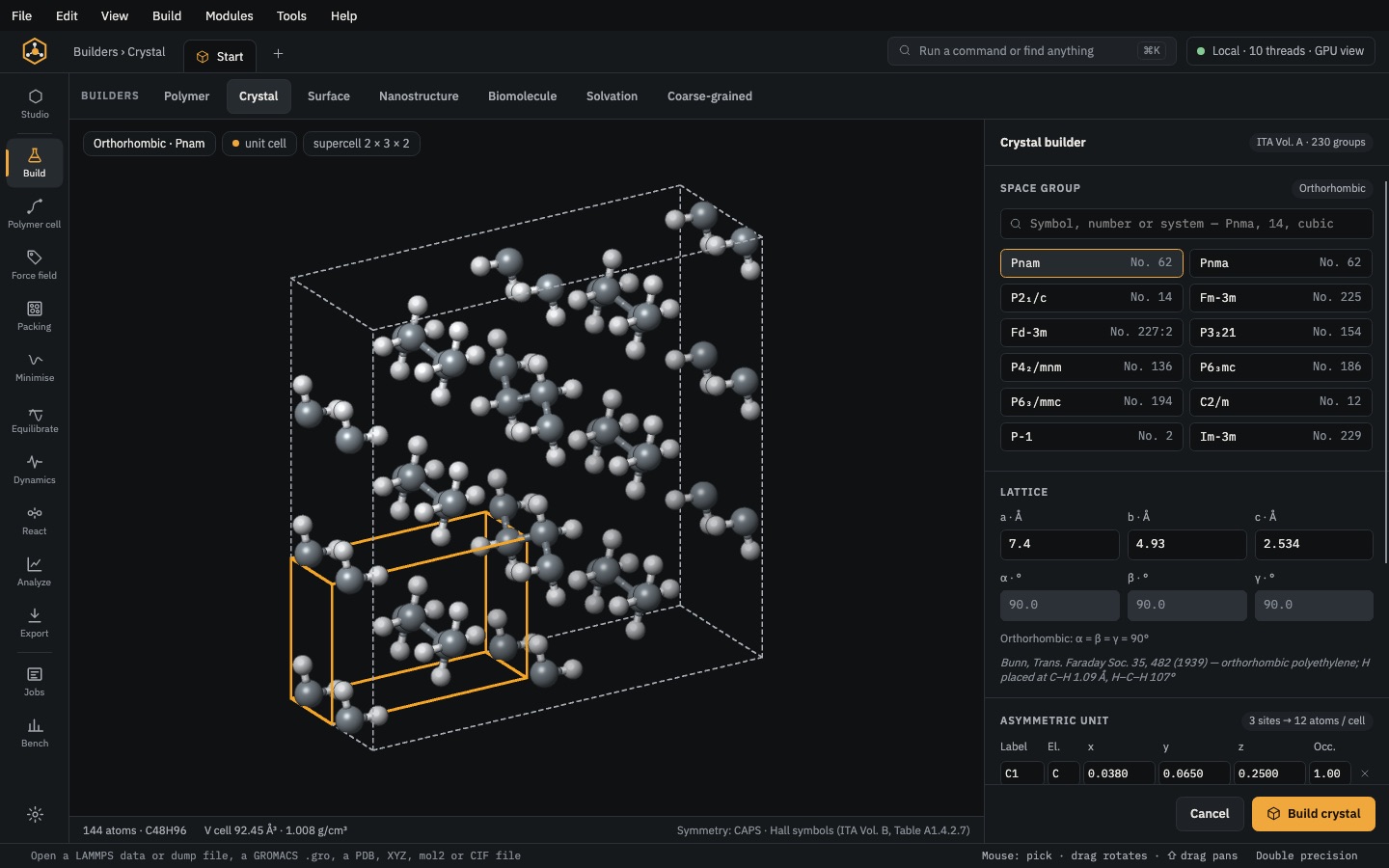 CrystalSpace group, lattice and sites; CIF import; supercells, primitive and Niggli cells, defects and nanowires.
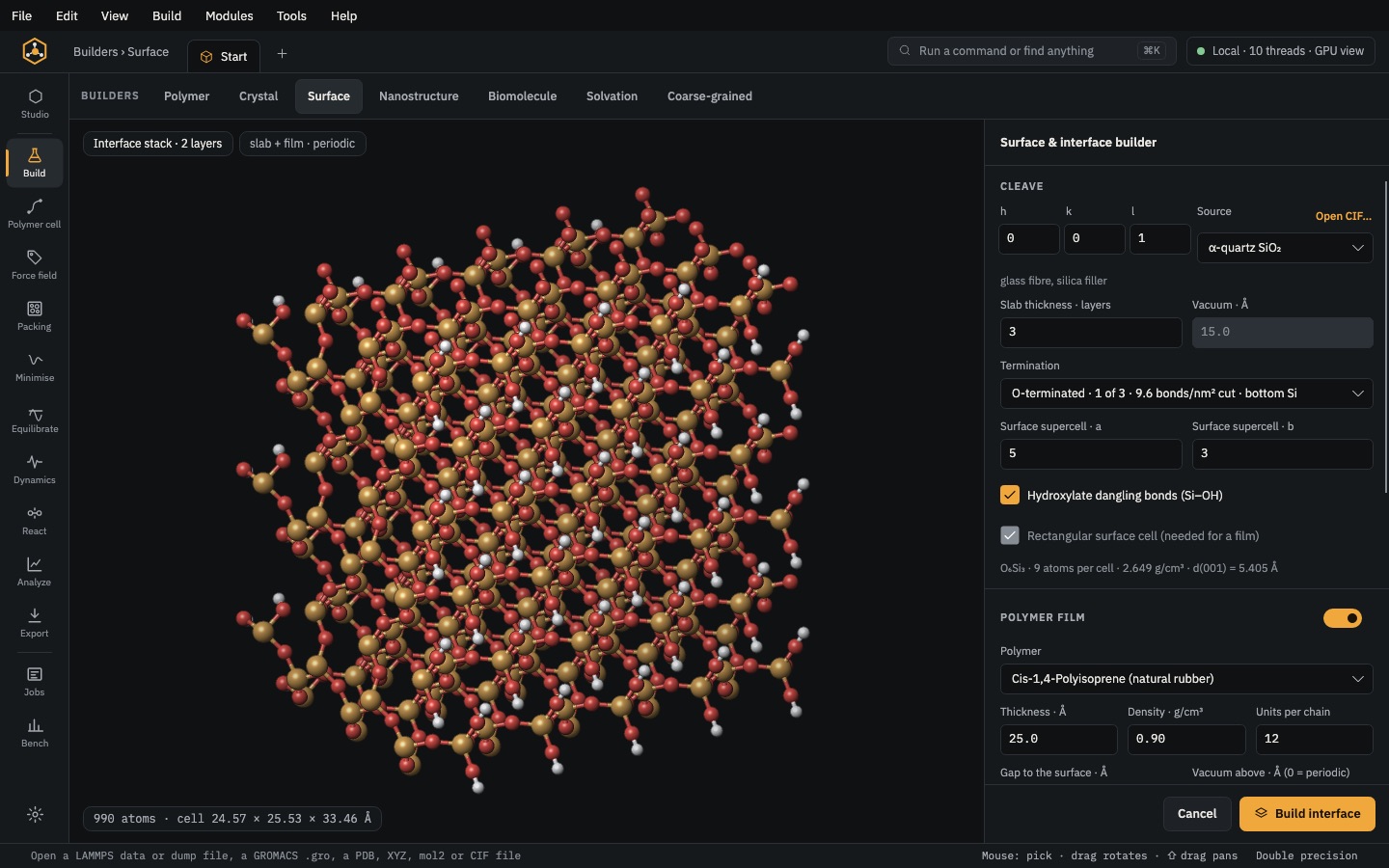 Surface & interfaceCleave a crystal along (hkl), choose the termination, add vacuum, and grow a polymer film or brush on it.
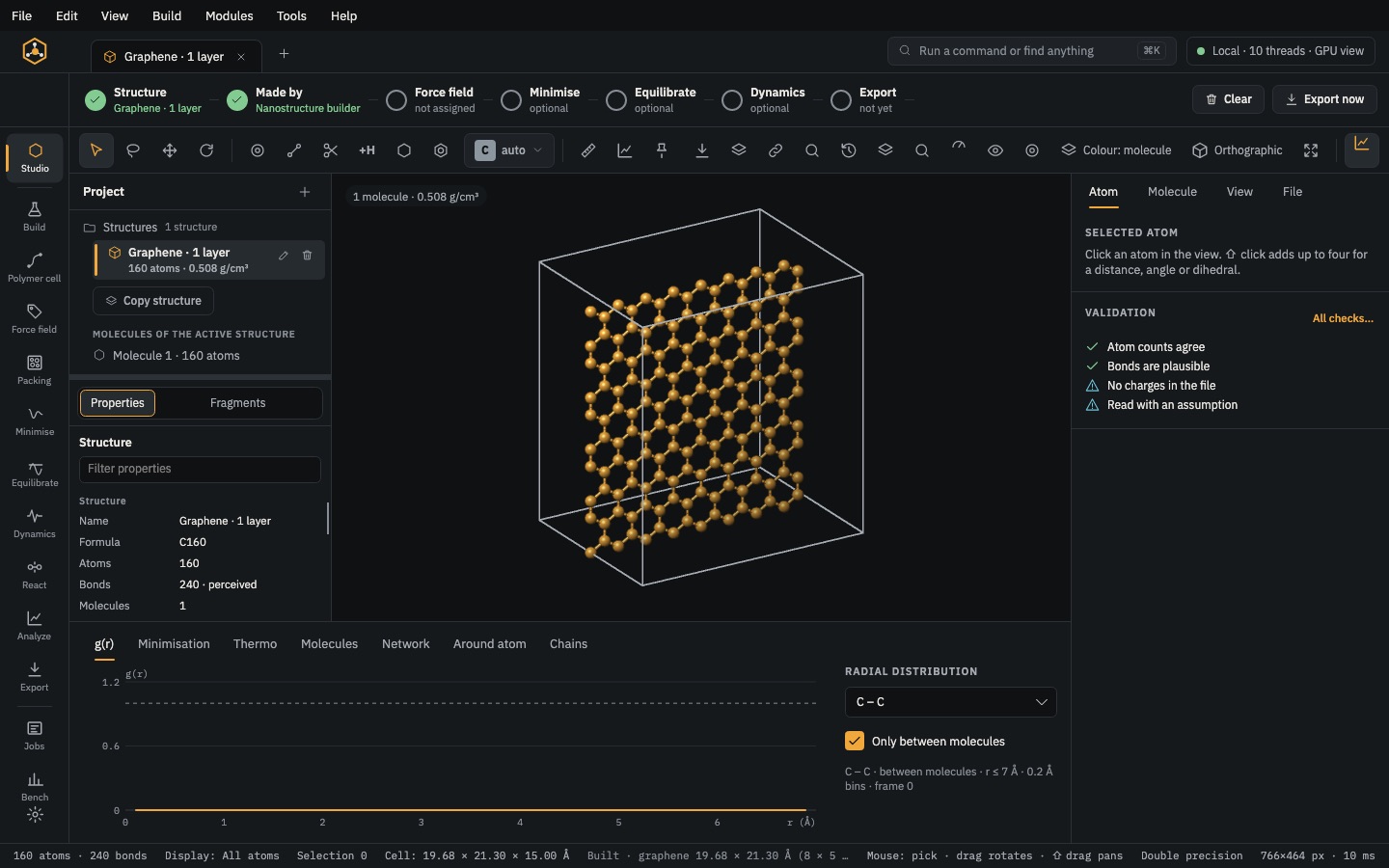 NanostructureGraphene and h-BN sheets, nanotubes, particles and pores; graft functional groups; grow a polymer matrix around them.
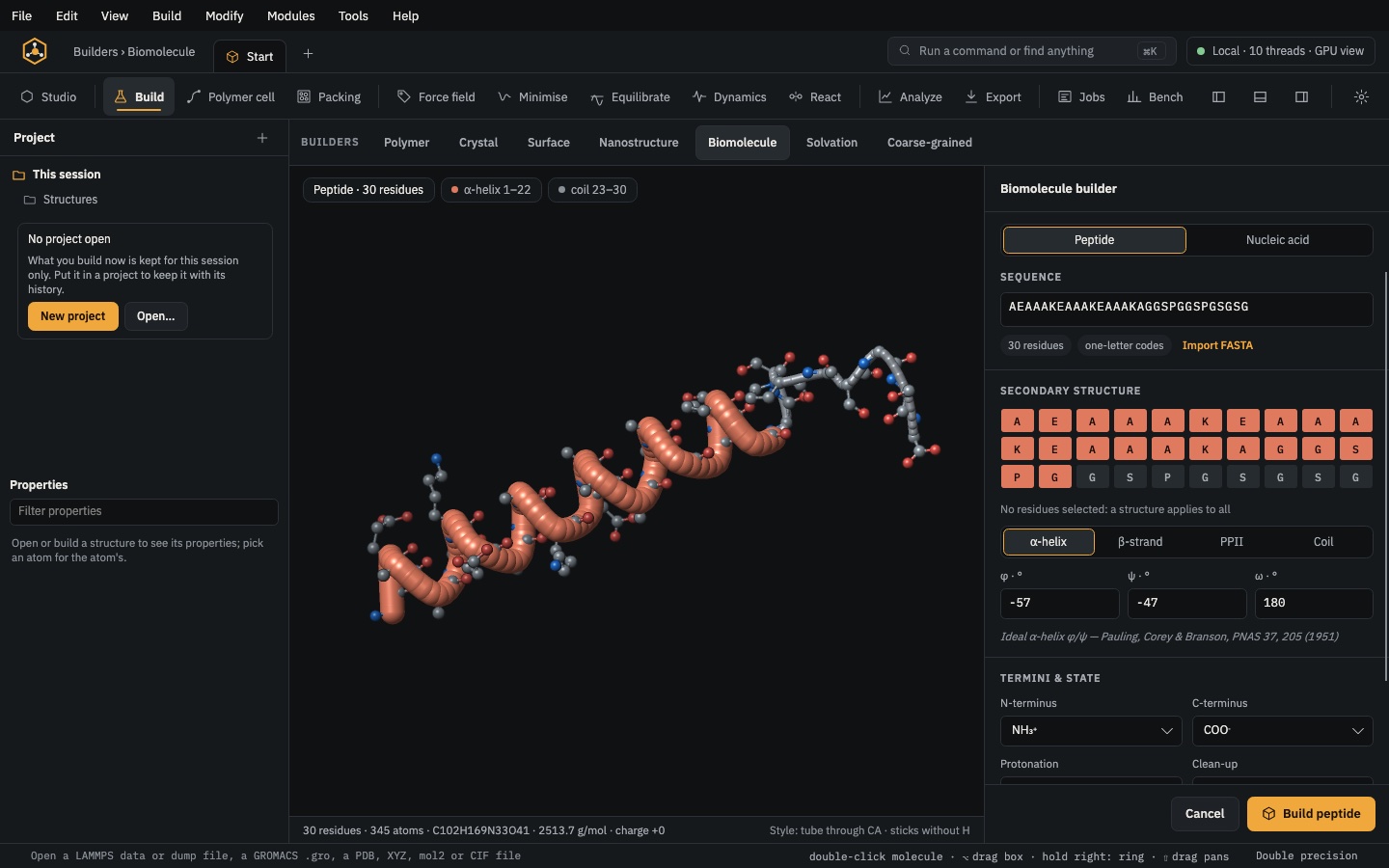 BiomoleculePeptides from a sequence with their secondary structure, termini and protonation; DNA and RNA strands.
Prepare
Give the structure a force field, take out close contacts and bring it to the density and temperature you want.
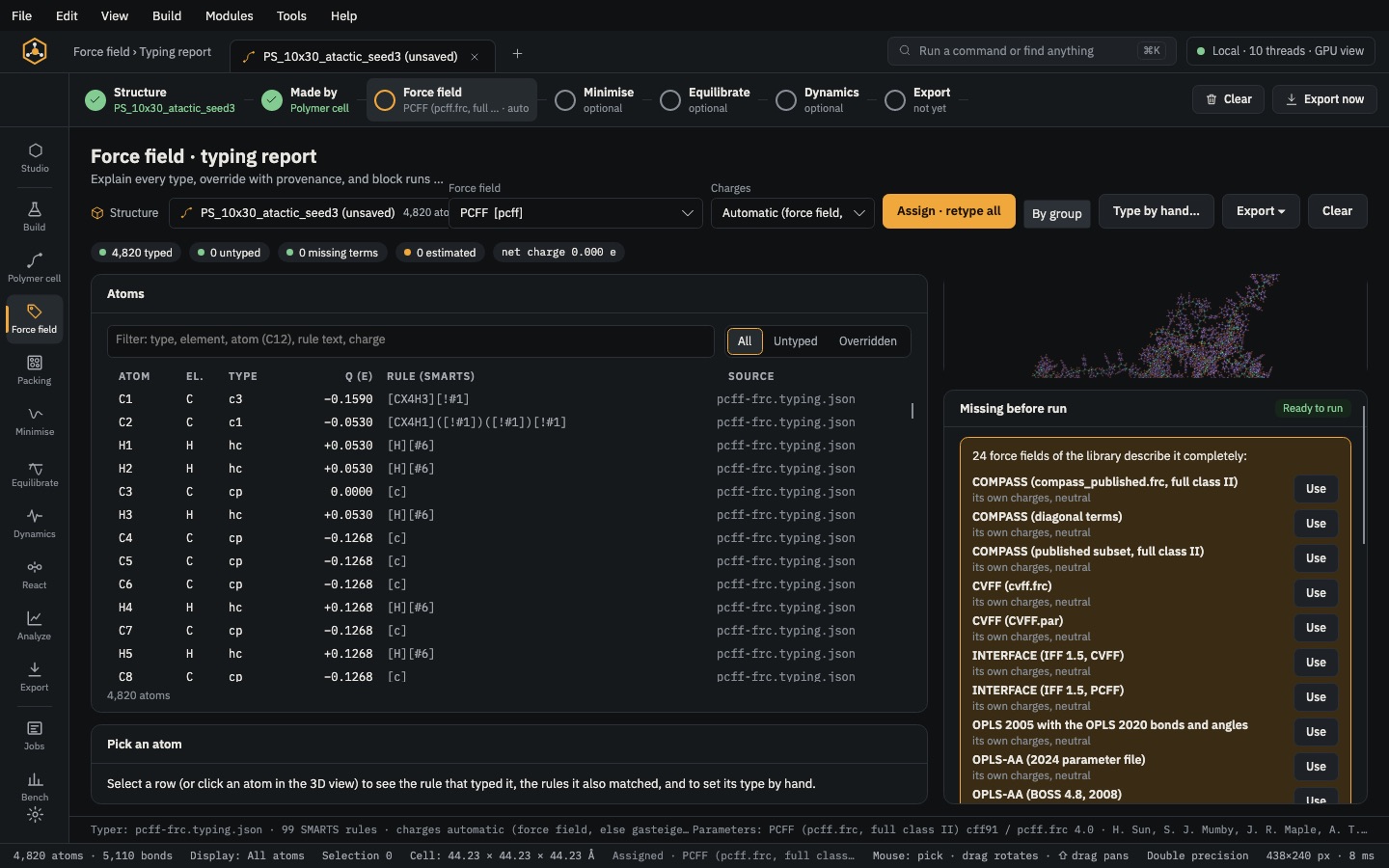 Force fieldType every atom from SMARTS rules, set charges, fill any missing term and give each part of a composite its own force field.
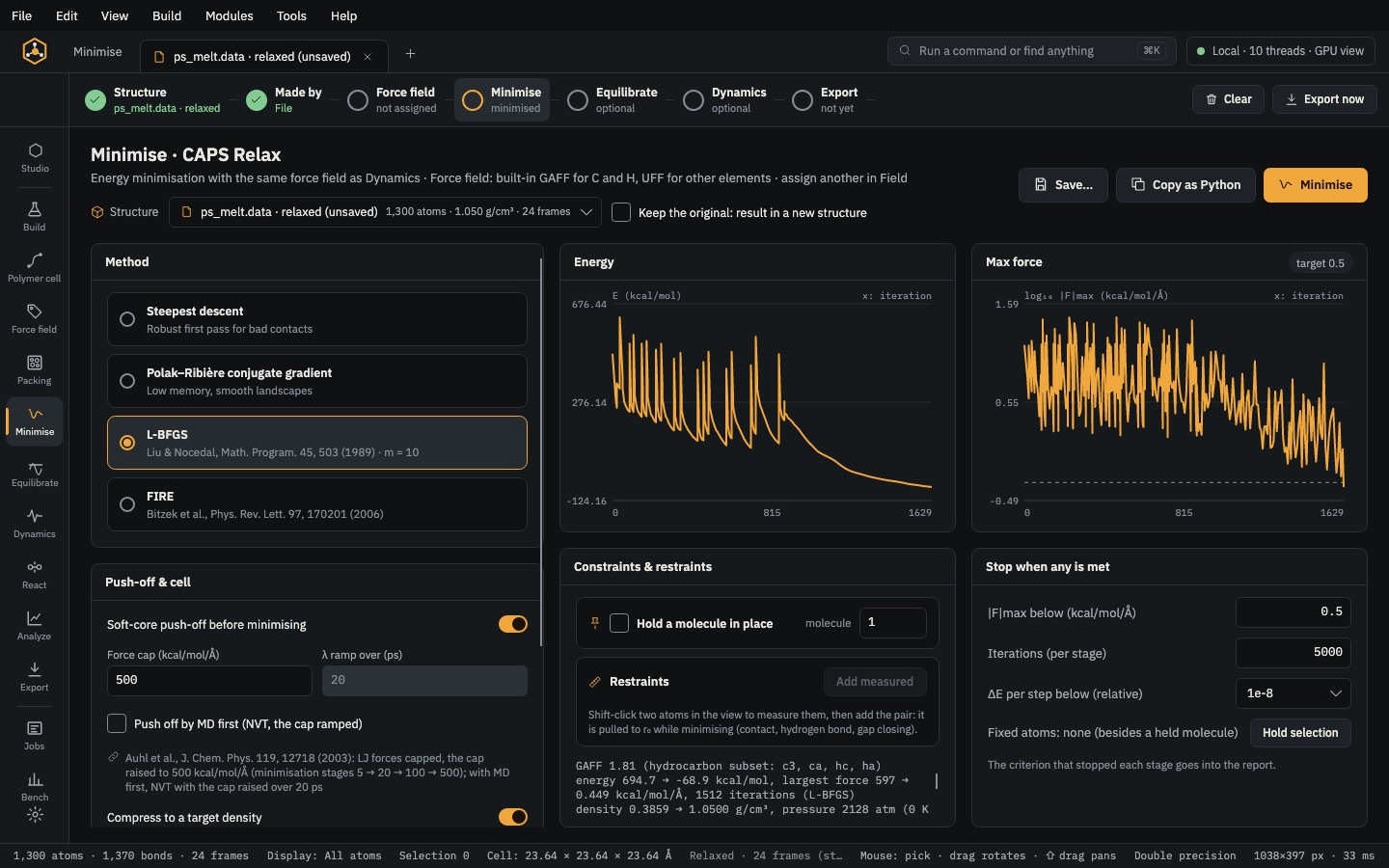 MinimiseRemove close contacts, compress a low-density cell to its target and relax the box.
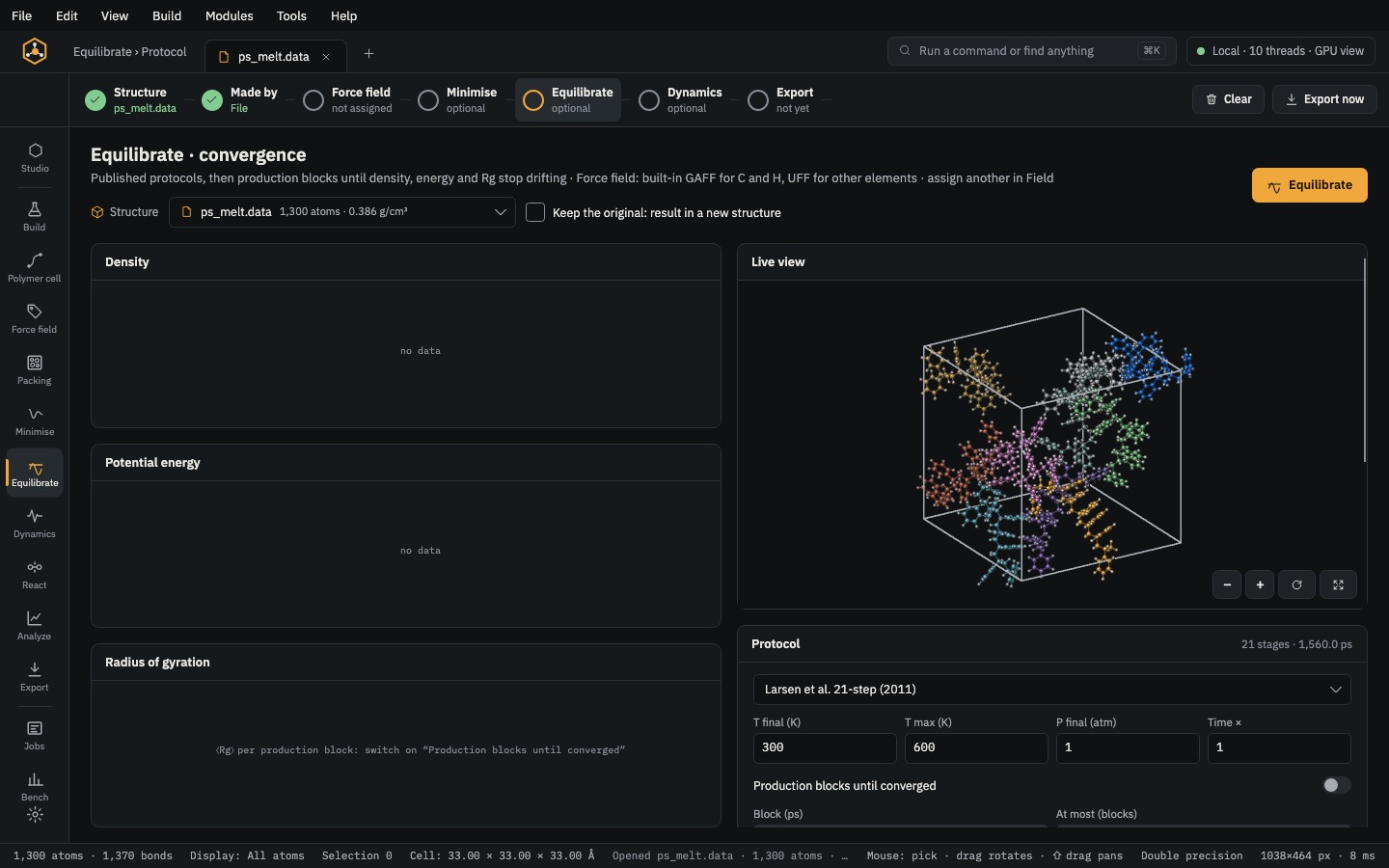 EquilibrateRun a published protocol such as Larsen's 21 steps, then production blocks until density, energy and Rg stop drifting.
Run
Molecular dynamics in CAPS, coarse-grained and mesoscale models, and adsorption on surfaces.
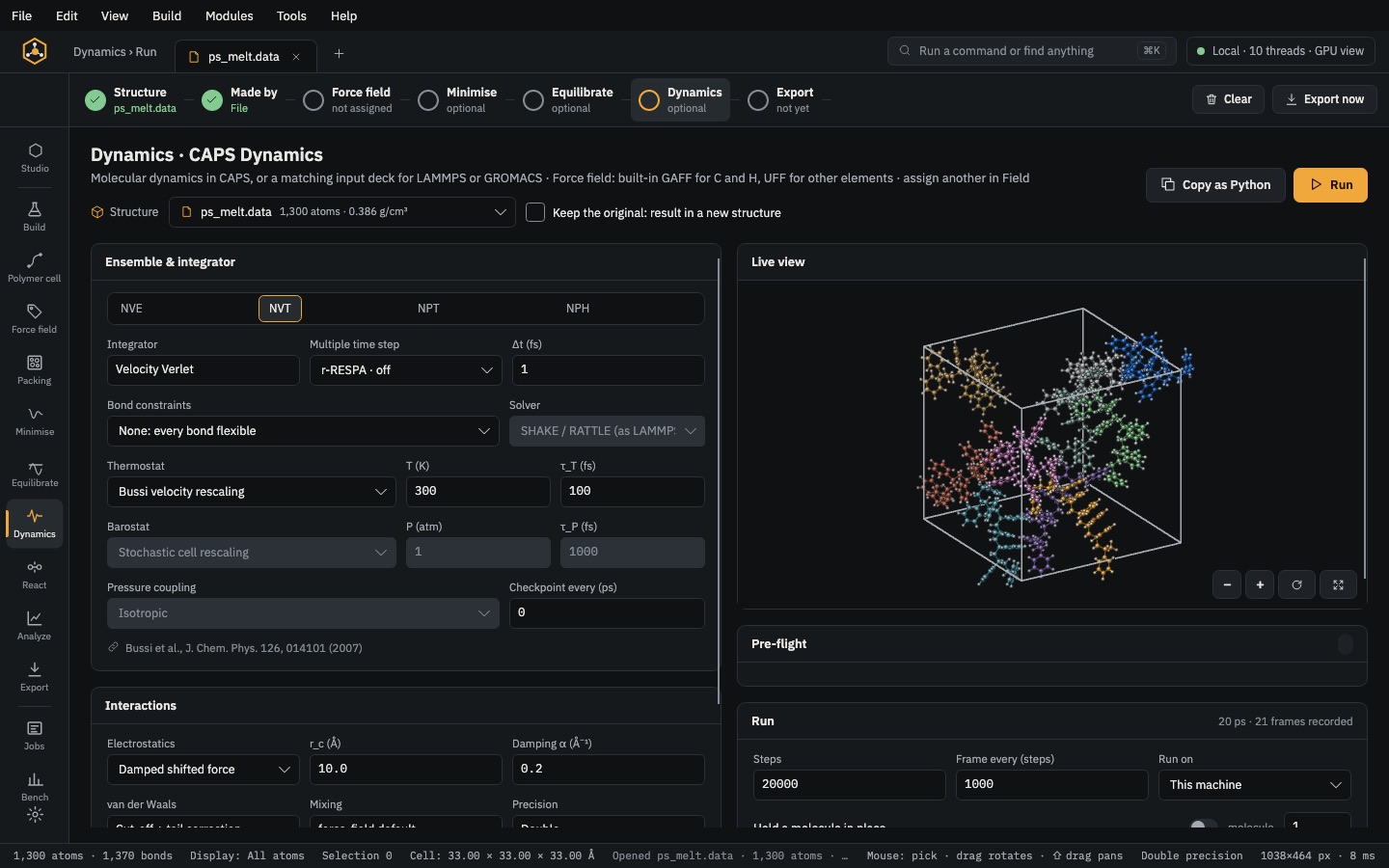 DynamicsNVE, NVT, NPT or NPH molecular dynamics in CAPS, with live snapshots, or a LAMMPS / GROMACS deck.
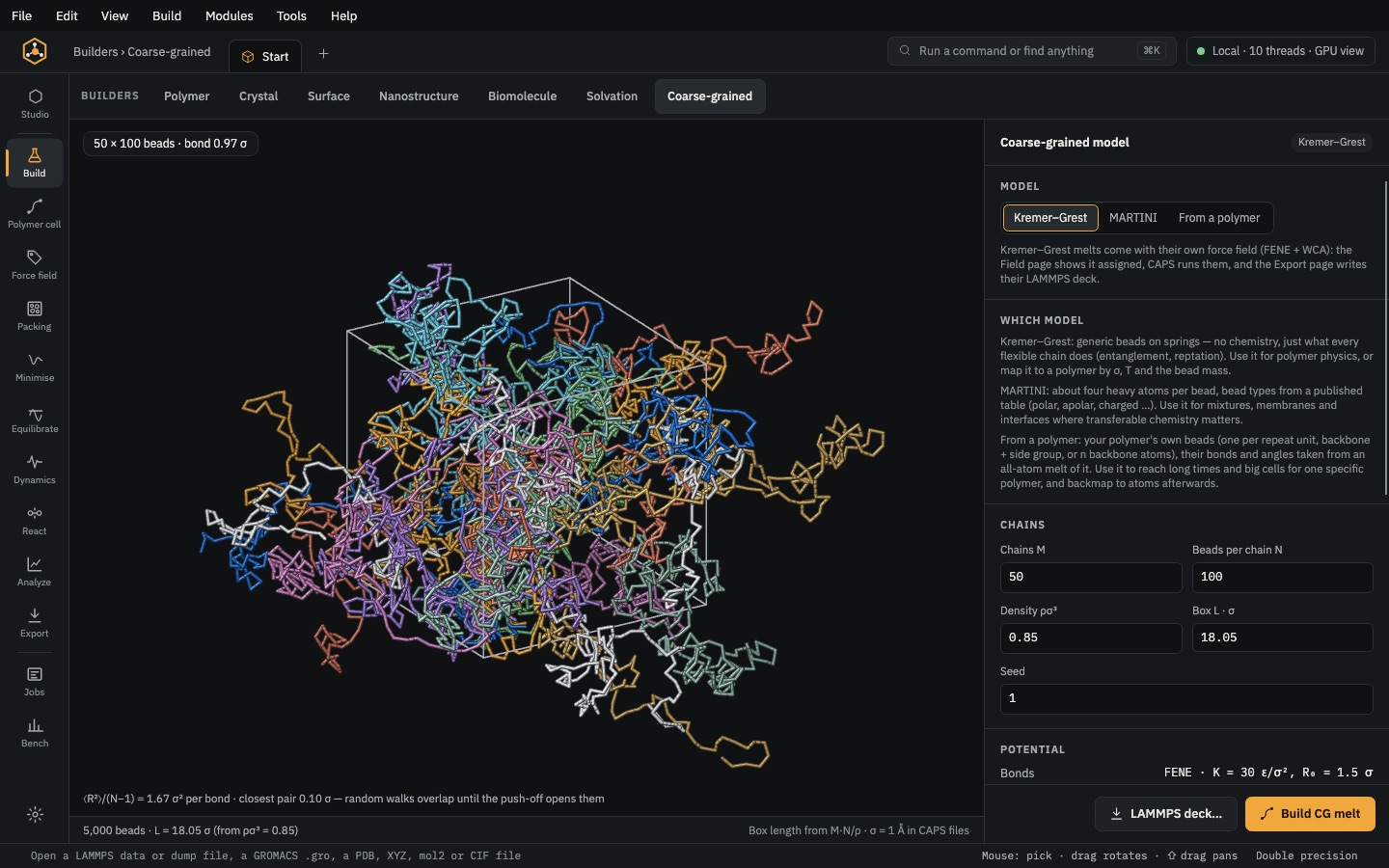 Coarse-grainedKremer–Grest, MARTINI, or beads derived from your own polymer — then backmap to atoms.
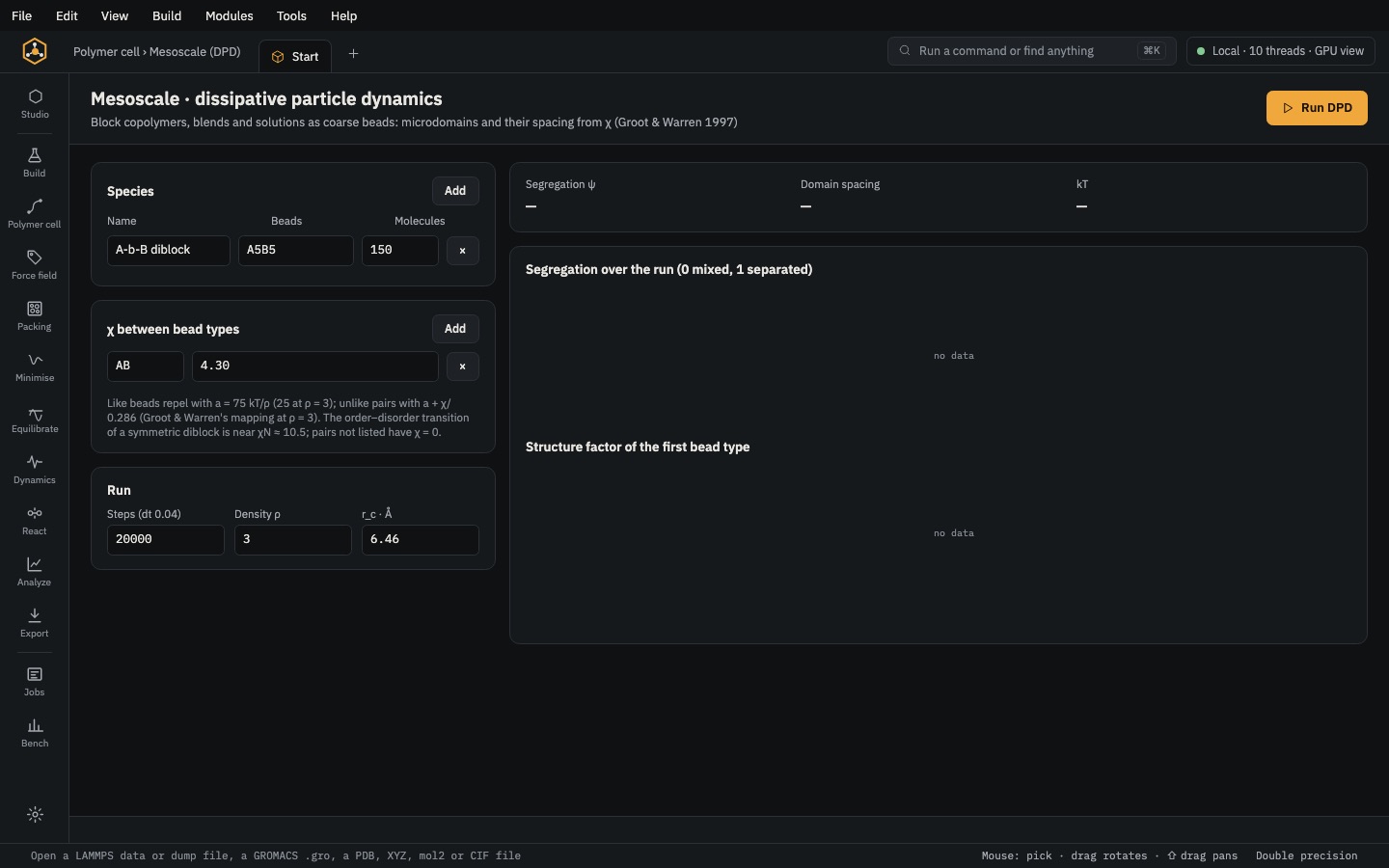 DPDDissipative particle dynamics for phase separation, lamellae and domains in blends and block copolymers.
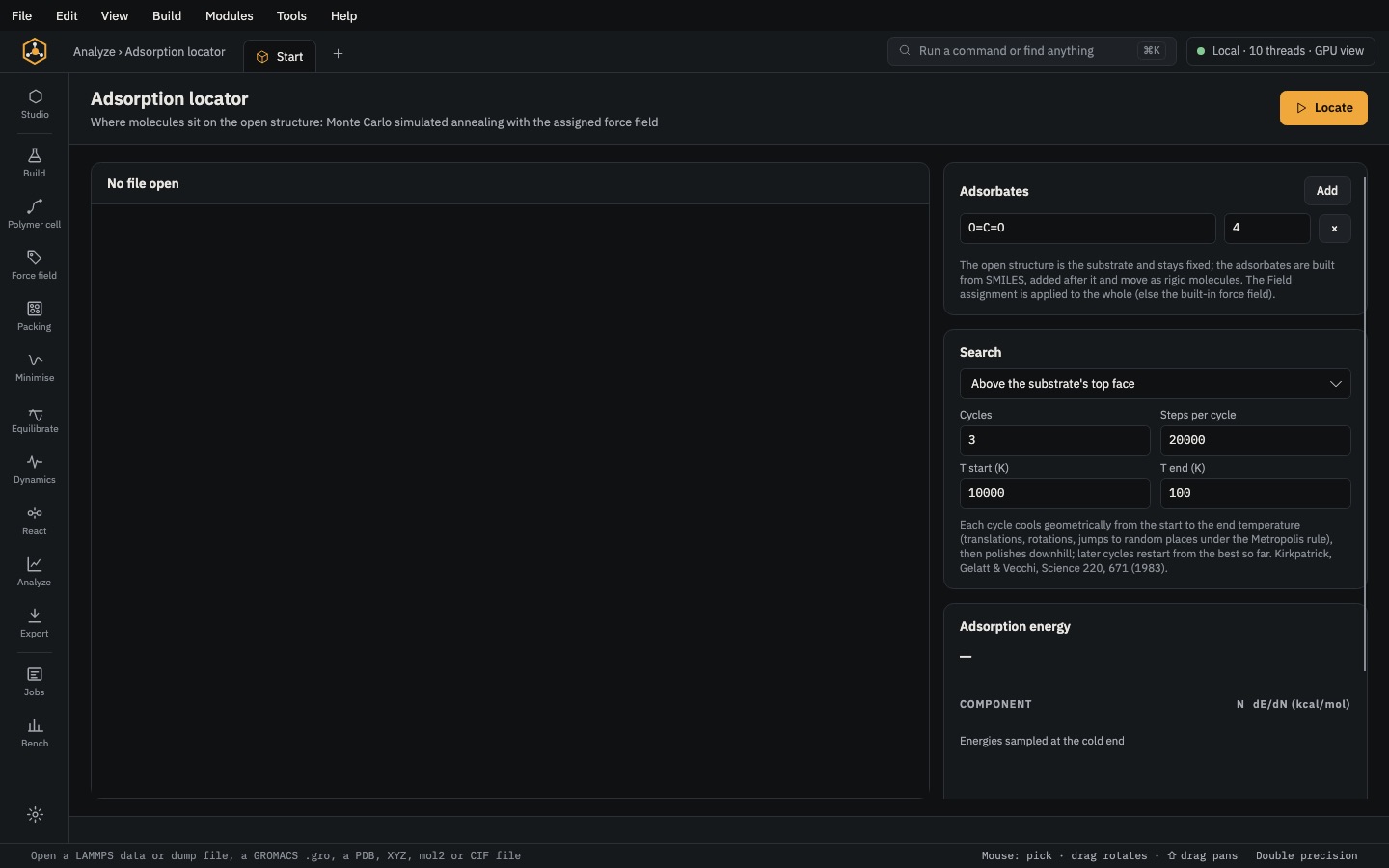 Adsorption & sorptionFind the lowest-energy places a molecule sits on a surface, and gas uptake isotherms by Widom insertion and GCMC.
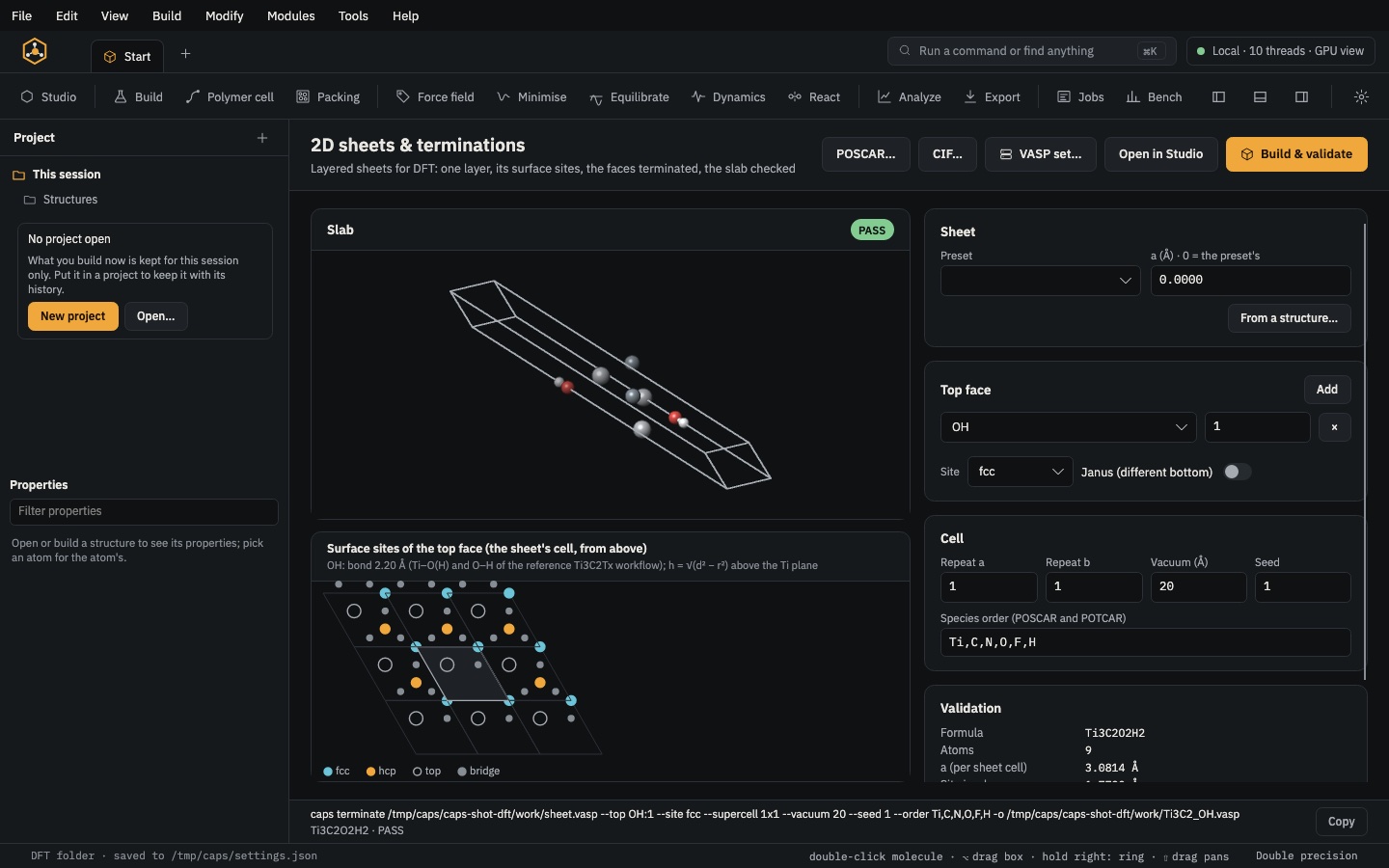 DFT workbench2D sheets and terminations, adsorption sets, VASP input sets, cluster runs and results — for surface DFT studies.
React
Crosslink, cure and vulcanise with reaction templates, in CAPS or as LAMMPS fix bond/react files.
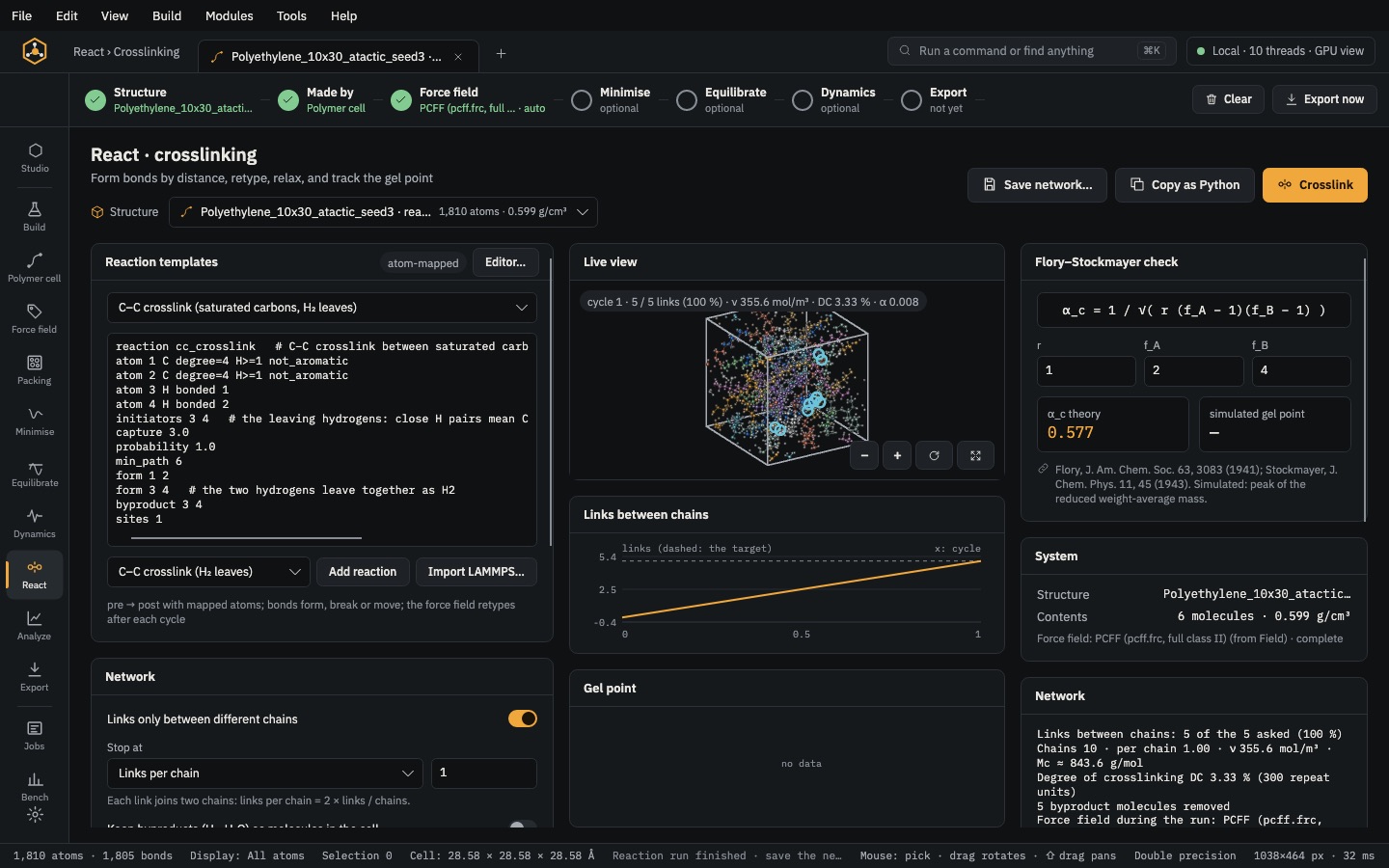 React
ReactAnalyse & export
Measure properties, write decks for LAMMPS, GROMACS and others, run jobs and draft the methods section.
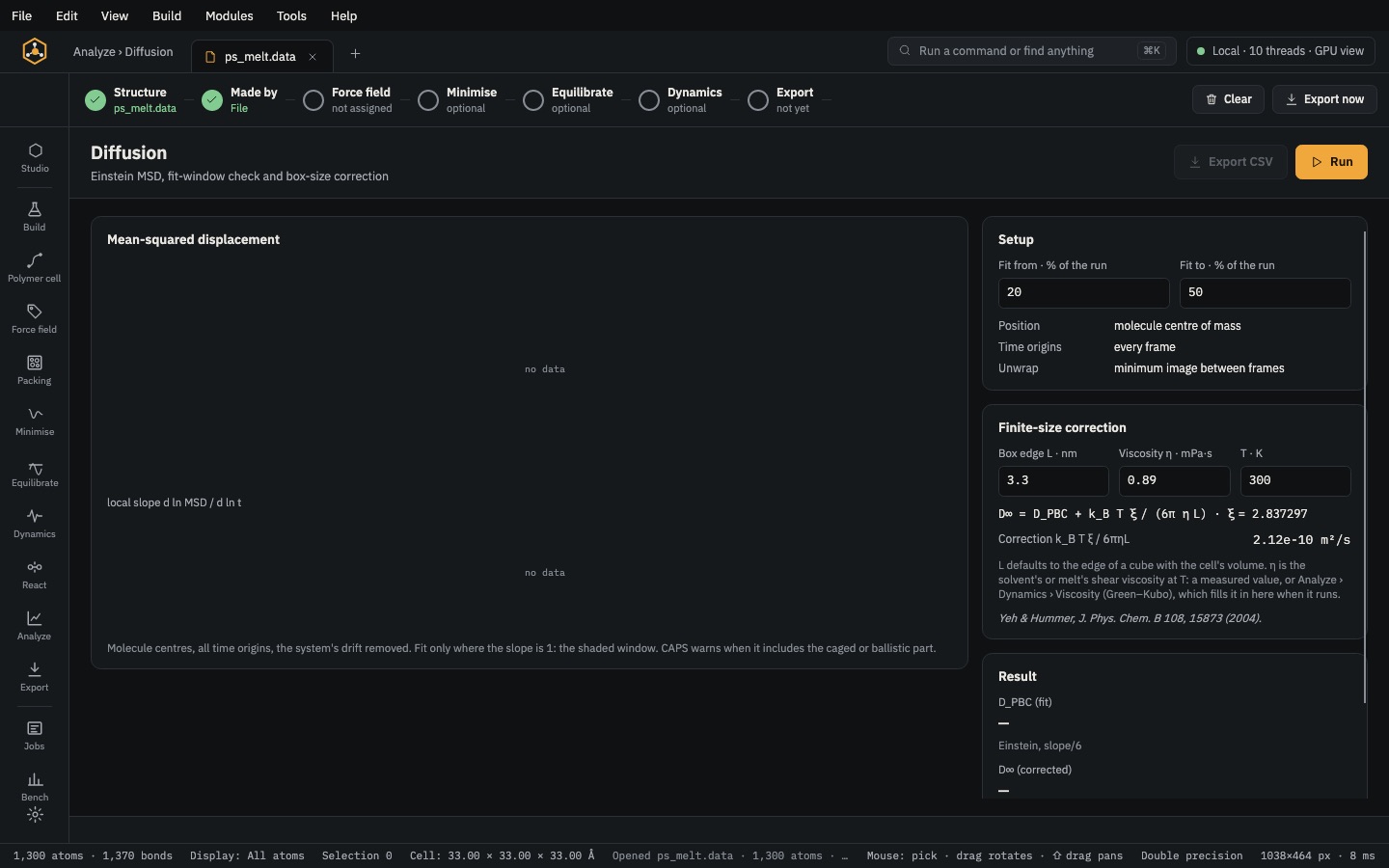 AnalyzeDensity, g(r), chain statistics, Tg, moduli, diffusion, free volume, interfaces and crosslink density — each with CSV.
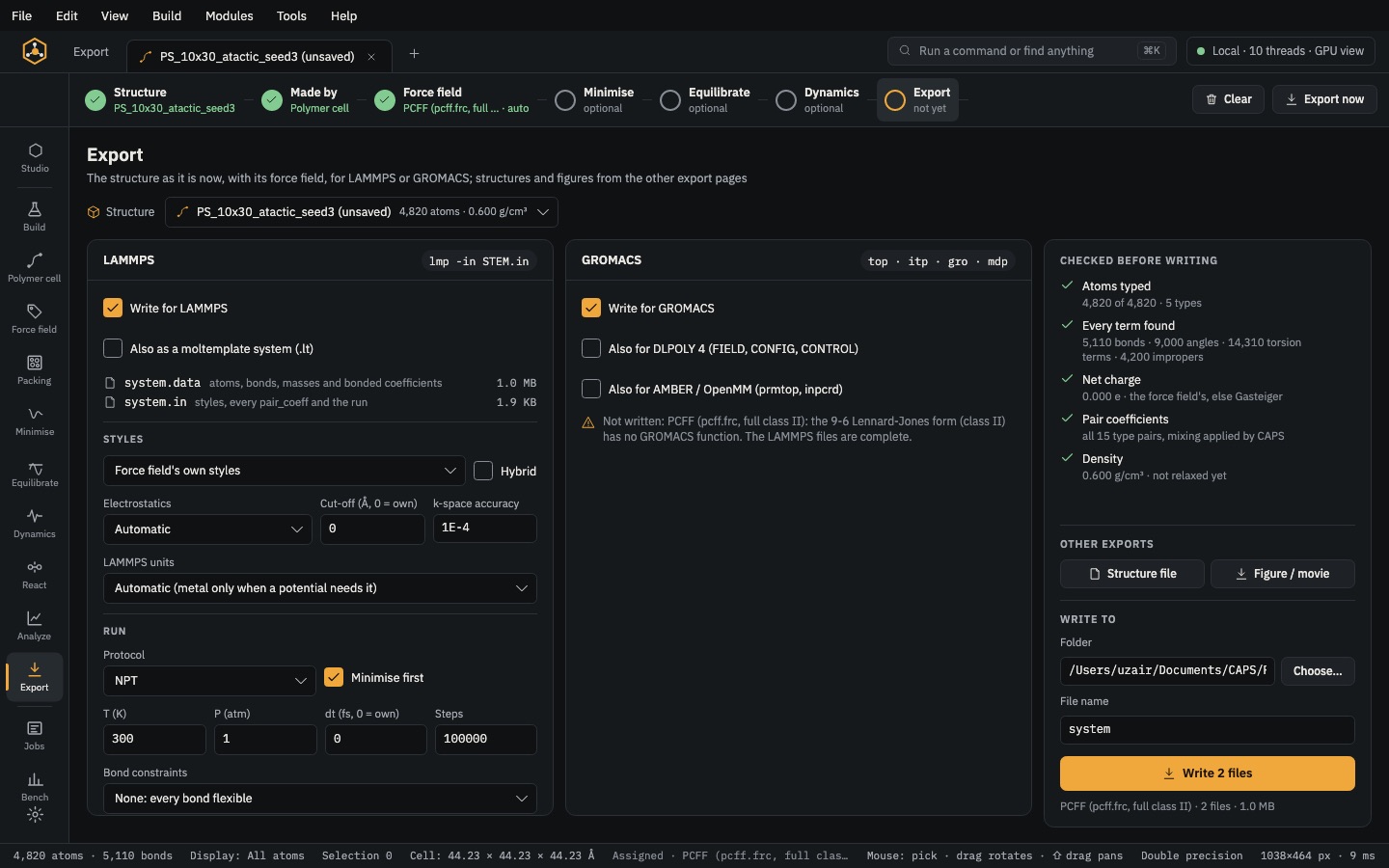 ExportLAMMPS, GROMACS, DL_POLY 4, AMBER/OpenMM and moltemplate decks, checked before they are written.
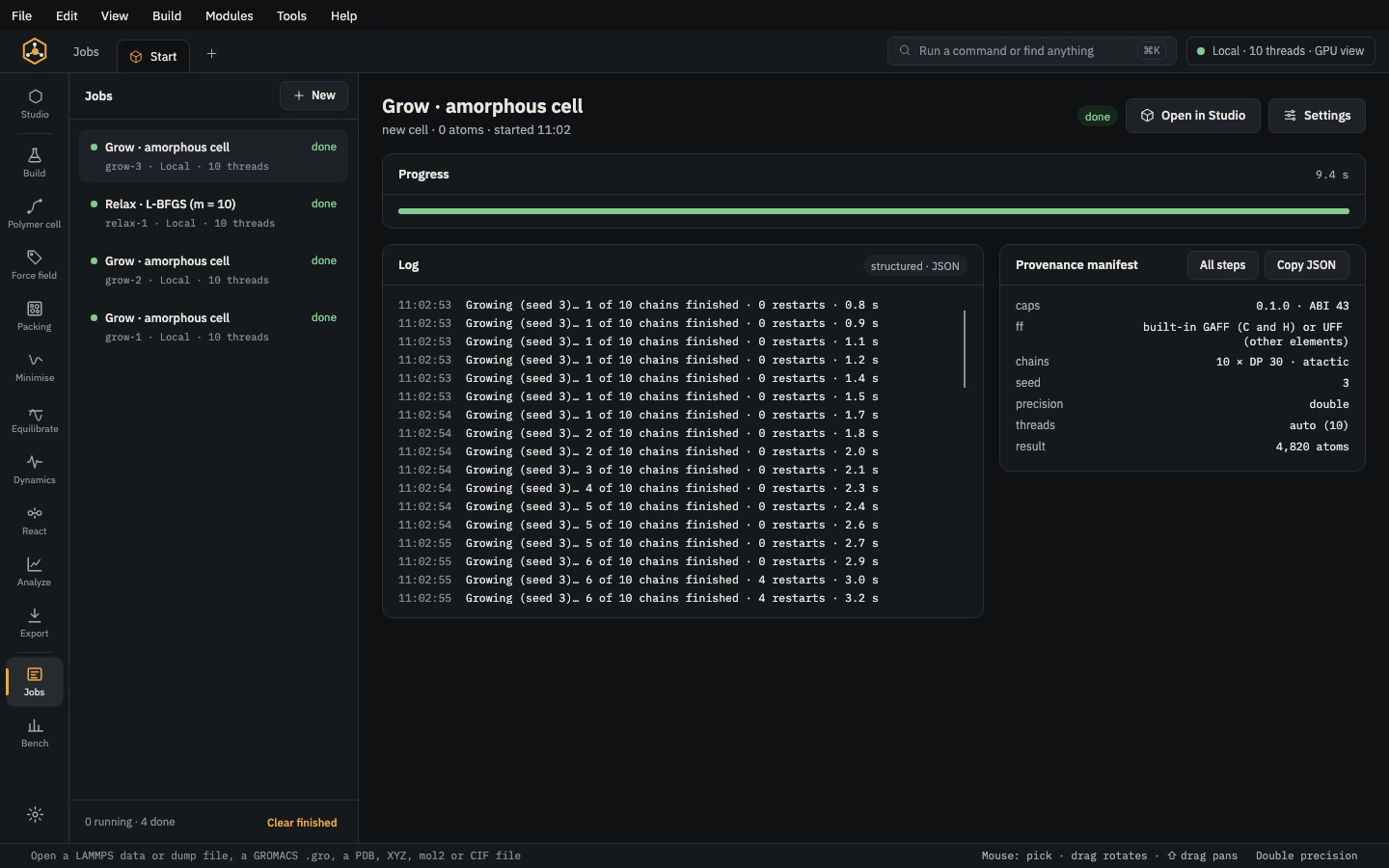 JobsEvery run, local or on a SLURM / PBS cluster, with live progress, logs and recovery hints.
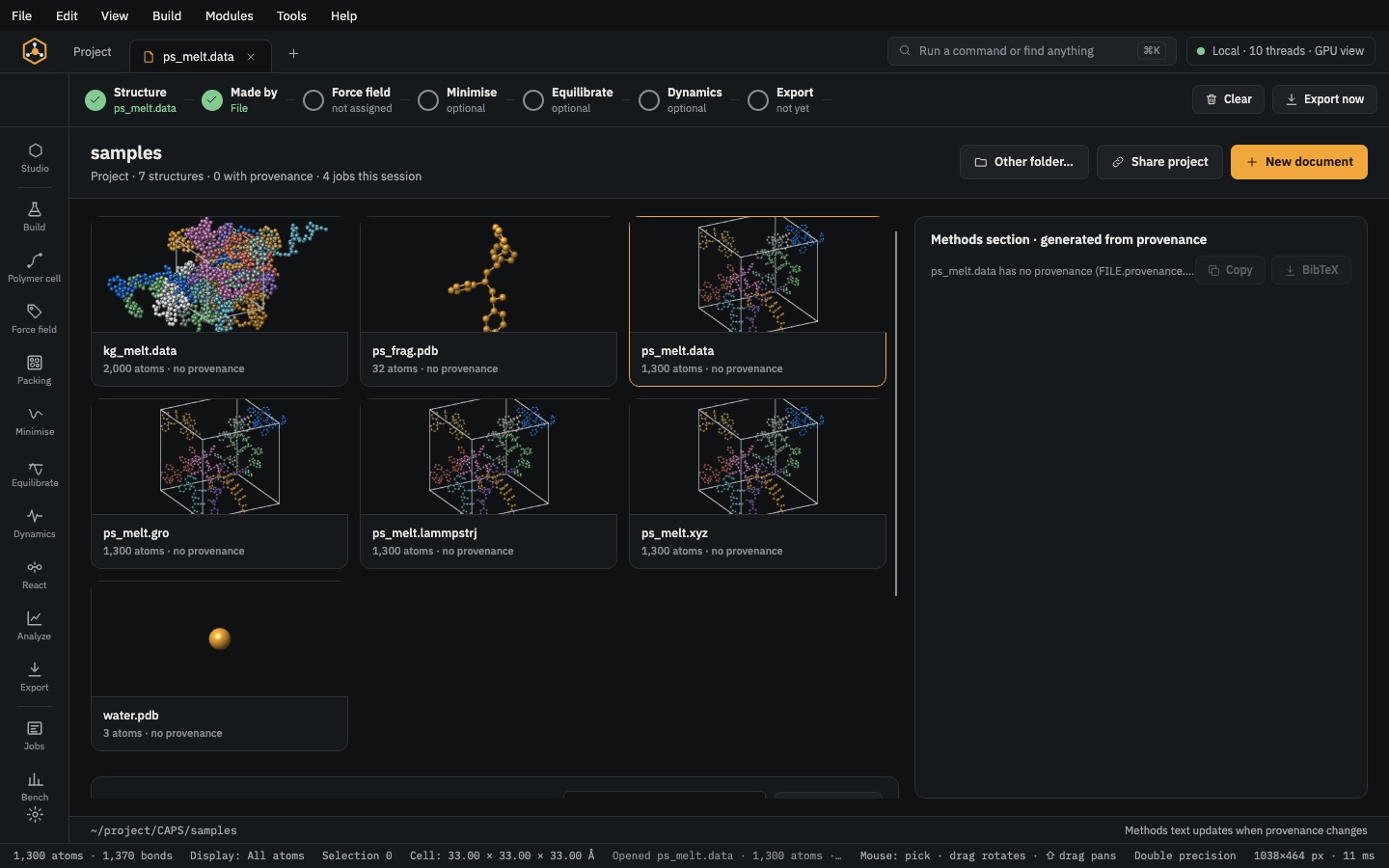 Project & methodsA results table for every structure and a methods section with BibTeX, written from provenance.