Build · module 04
Polymer builder
Define the chain: pick a polymer from the library or write a repeat unit, then set the architecture, sequence, composition, tacticity, linkage and end groups, and preview one chain in 3D.
Open it Top bar›Build
- You start with
- A polymer from the library, or a repeat unit as SMILES with two
*(head first). - You get
- One chain in the Studio, or the polymer handed to Polymer cell to grow a cell.
Step by step
Choose the repeat unit
Search the Library by name or SMILES; Rubbers filters elastomers. Or type a SMILES under Repeat units: the first
*is the head, the second the tail (for example*CC(*)c1ccccc1). Unit adds a second unit for a copolymer.Set the architecture
Linear (default), Branched, Star, Comb or Dendrimer, with arms, generations or branch probability. Network → goes to React.
Graft puts side chains of another repeat unit on the backbone: the graft unit as SMILES with two
*, the graft probability per unit and at most so many per chain (0: no limit). Mark the backbone atom a graft starts on with an atom class,[CH:3](natural rubber:[*]CC(C)=[CH:3]C[*]); without a mark it starts on the head or tail atom.Set the sequence and length
Homopolymer, alternating, block, random, gradient, pattern (for example
AAB) or random with exact composition. Degree of polymerisation 2–2000, and a name.Copolymers: set the composition
Give each unit a target % by moles or by weight; CAPS converts weights to mole fractions with the repeat-unit masses and shows each unit's count per chain. Use: random or Use: exact composition (every chain holds exactly those counts).
Copolymers from reactivity ratios
Build › Copolymer builder… draws a chain from the monomers' reactivity ratios r₁ and r₂ and the feed f₁. Under Model and drift: Terminal (last unit) or Penultimate (last two units) (two monomers, with r₁′ and r₂′); a third monomer M₃ with its feed f₃ and four more ratios; and drift as the faster monomer is used up, Drift between chains (batch) or Drift along each chain (living), up to a final conversion.
The page shows the composition and the sequence head to tail, the model against this chain; Redraw draws another. A copolymer cell grown in Polymer cell gets its composition and run lengths, model against cell, in the Grow log.
Dendrimers and hyperbranched molecules
Under Dendrimers from units, pick the Family (PAMAM with an EDA core, PPI with a DAB core, bis-MPA with a TMP core, or your own units) and the Growth: Perfect (every site) shell by shell to a generation, or a hyperbranched molecule by Slow monomer addition or Flory statistics (no core) with a number of units and a seed. Your own units are SMILES with an A site
[*:1]and B sites[*:2].Build dendrimer opens the molecule as a new structure and reports the units per shell, the dendritic, linear and terminal units and the degree of branching.
Stereo, linkage and ends
Atactic, isotactic or syndiotactic (or a dyad pattern); head-to-tail, head-to-head or random reversals; end groups such as hydrogen, methyl, phenyl or hydroxyl.
Build
Build in document builds one chain and opens it. Send to CAPS Grow takes the polymer to Polymer cell to grow a periodic cell. Save to your library keeps it for later.
Graft chains onto a structure
Under Graft onto the open structure, pick atoms in the view of the open structure (a filler surface, a chain) and press Graft onto picked atoms: chains of the units above, of the DP set on the page, grow from them while the structure stays where it is; each picked atom gives up a hydrogen. Every equivalent atom grafts on every atom like the one you picked. Set the probability, the most grafts in all and the spacing between sites. Undo with ⌘Z.
The same without the Studio
Every Studio page calls the same core as the caps command and the caps Python package, so a step you clicked can be repeated in a script.
caps grow -o graft.data --units '[*]CC(C)=[CH:3]C[*]' --architecture graft \
    --graft-units '[*]CC(C)(C(=O)OC)[*]' --graft-dp 10 --graft-probability 0.1 --chains 4 --dp 40
caps copolymer --feed 0.5,0.5 --r1 0.5 --r2 0.5 --conversion 0.9 --csv drift.csv
caps dendrimer --preset pamam --generation 3 -o pamam_g3.pdb
import caps
chain = caps.polymer("*CC(*)c1ccccc1", dp=20, chains=1, tacticity="syndiotactic")
chain.save("sps_chain.pdb")Where to go next
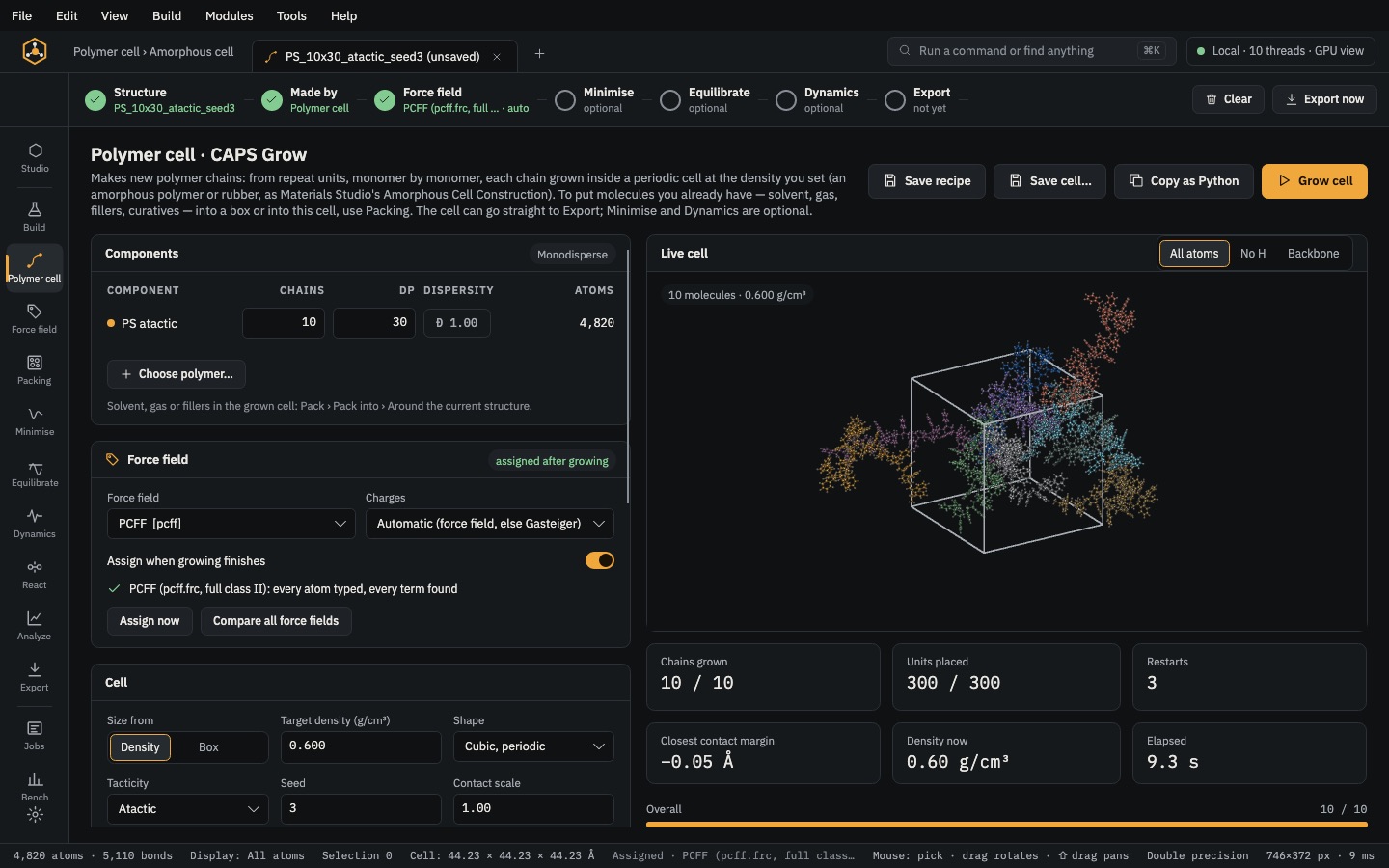 BuildPolymer cellGrow amorphous chains into a periodic cell at a target density, with the force field assigned when growth ends.
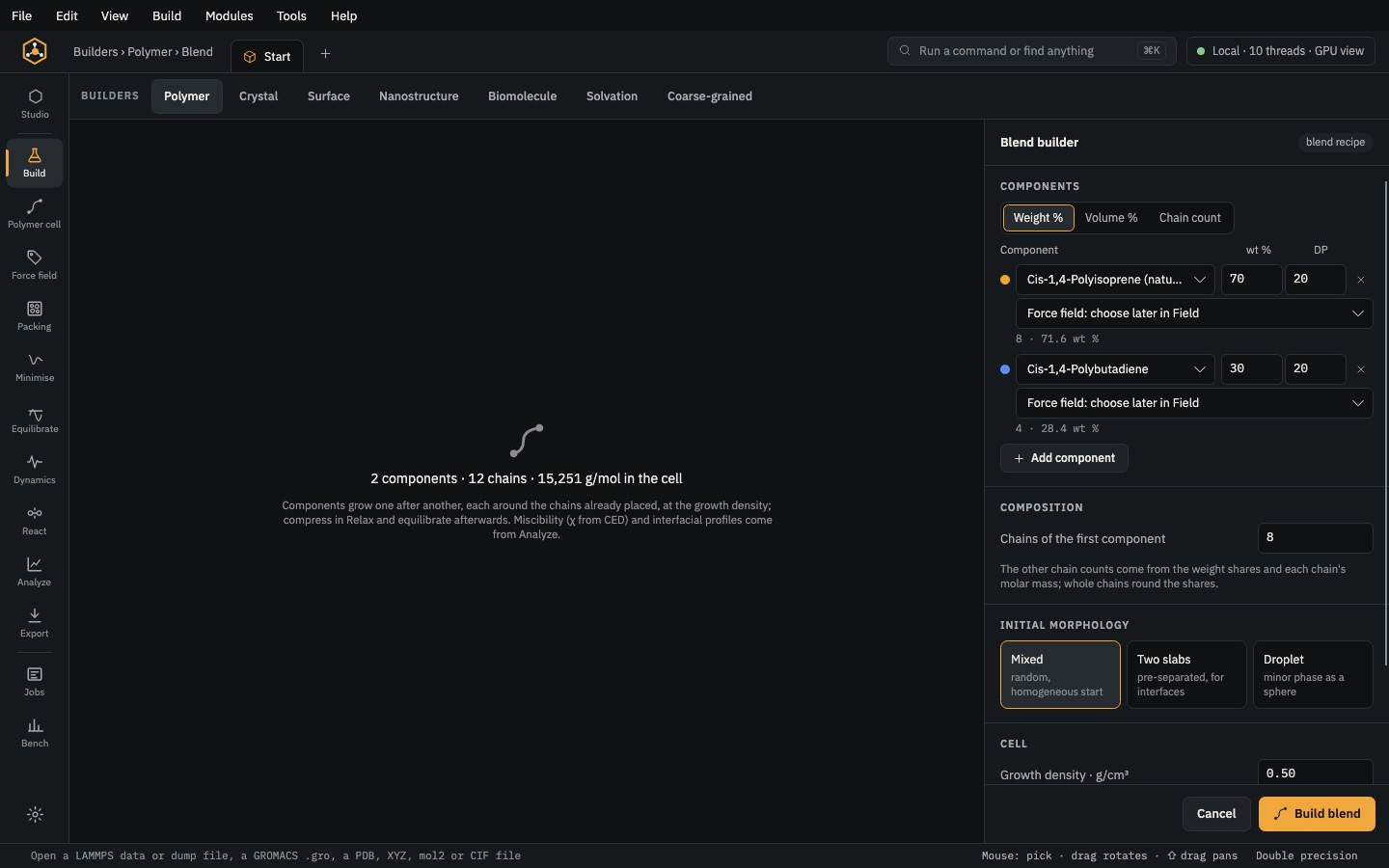 BuildBlendSeveral polymers grown together in one cell: mixed, as two slabs, or as a droplet.